Per aspera ad astra
星河入梦
China, 2026, colour, 2.35:1, 110 mins.
Director: Han Yan 韩延.
Rating: 3/10.
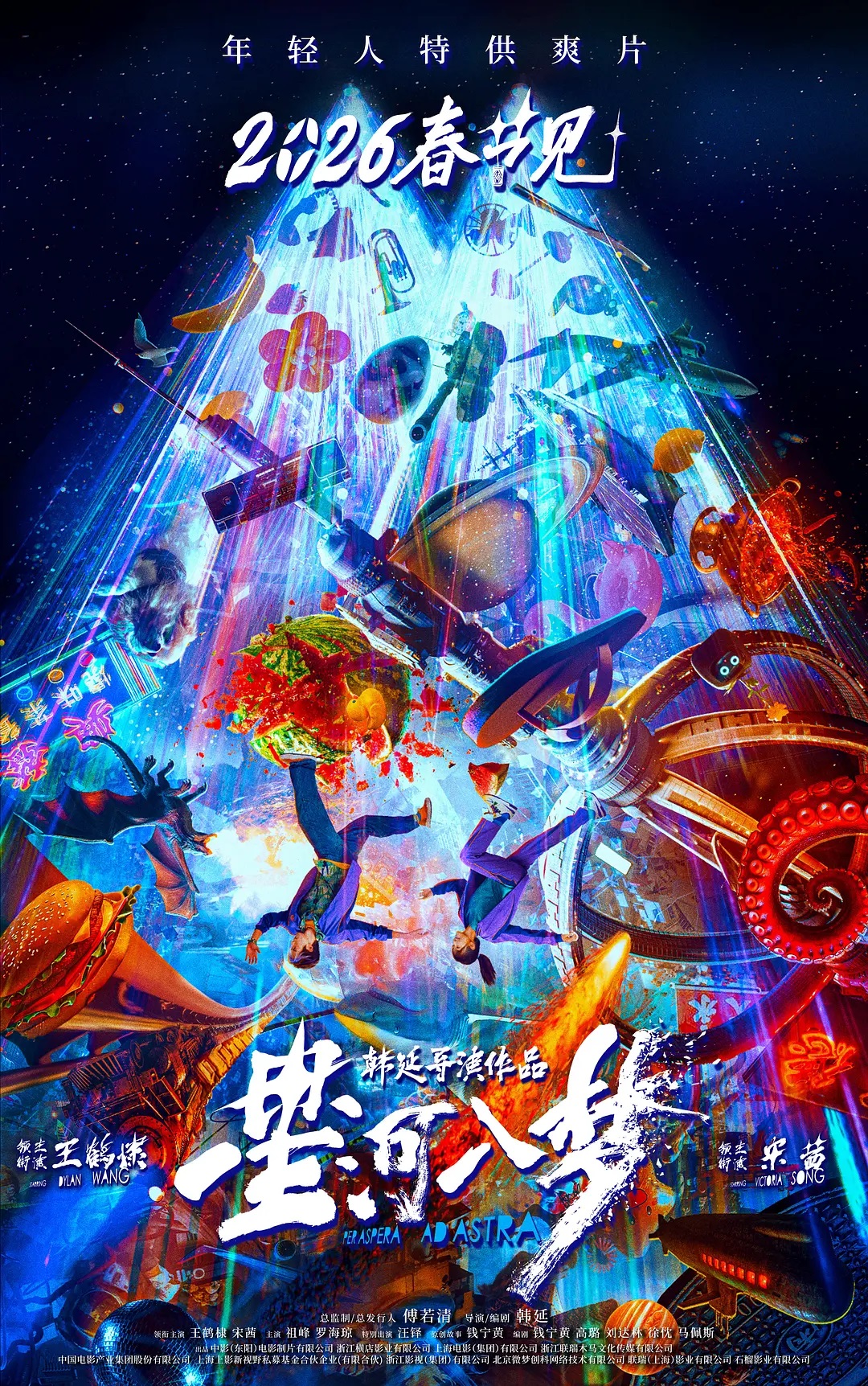
Unoriginal drama set on a deep-space shuttle ship hijacked by a crew member and its AI dream system soon becomes an utterly chaotic VFX-athon.
 STORY
STORY
Some time in the second half of the 21st century, post 2058. Around 60½ years into the 65-year flight of interstellar shuttle ship The Mengya to Planet K97 Sailun on a farming development mission, Xu Tianbiao (Wang Hedi) is woken up from suspended hibernation. The ship still has about 4½ years before reaching Sailun. Xu Tianbiao is an employee of Sweet Dreams LM 良梦, a laboratory that has solved the problem of neuro-degeneration during interstellar flights by allowing people to create dreams of their own choosing to keep their brains active during hibernation. However, the waking-up process has to be handled delicately, otherwise there’s a risk of brain damage. On The Mengya he is in charge of the ship’s Sweet Dreams LM system that is handling the hundreds of crew in deep-sleep hibernation. Soon after he is woken, a problem occurs outside the rear of the ship and Xu Tianbiao decides to wake up the captain, Li Simeng (Song Qian). He breaks into her dream of sitting a high-school exam that could help her eventually become an astronaut, like her mother (Luo Haiqiong). She is annoyed by his presumption and his general lack of respect for her authority. But she investigates and identifies the problem: two power modules have exploded. She tells him to wake up Bai (Zu Feng), head of the tech team; but to do so quickly and safely he devises a plan for both of them to enter Bai’s current dream, which revolves around him being an oldstyle, 20th-century Hong Kong gangster. After five attempts, entering and leaving his dreams at different points, they eventually wake him up safely. Li Simeng and Bai replace the power modules outside the ship but are hit by a sudden swarm of meteorites. Xu Tianbiao manages to save both their lives; but then Li Simeng discovers the ship is now very slightly off-course and heading straight towards a meteorite belt that will destroy it. The only solution is to quickly wake Ge Yang (Wang Duo), the ship’s chief software engineer, by the same process used with Bai. But this proves even more tricky, involving dreams within dreams. They also discover that Ge Yang has been sabotaging the ship and stealing other people’s dreams.
REVIEW
There’s hardly an original idea or image in Per aspera ad astra 星河入梦, a sci-fi drama for Generation Z that draws on every movie from 2001: A Space Odyssey (1968) to more recent fare like Paprika パプリカ (2006) and Passengers (2016) for its content. The story of a long-hawl interstellar shuttle ship that’s hijacked en route by its AI system and a crew member who manipulates the suspended hibernation dream process can be seen as a general warning against AI but, like many of its kind, also exploits it to the full, going into VFX maxi-overdrive in the second half after a more character-driven beginning. Among the big five players in this year’s Chinese New Year stakes, it came in last, taking a nothing RMB102 million (for a reported budget of around RMB400 million). Increasingly bombarded with AI and other technology in their own lives, Mainland audiences went instead for more human entertainment, with rally-driver comedy-drama Pegasus 3 飞驰人生3 sweeping the board with a take of RMB4.40 billion, over 40 times that of Aspera. Even the feeble Cheng Long 成龙 [Jackie Chan] comedy-fantasy Panda Plan: The Magical Tribe 熊猫计划之部落奇遇记 took more than twice as much as Aspera.
The film is quite a departure for Shandong-born writer-director Han Yan 韩延, 42, most of whose notable films – First Time 第一次, 2012; Go Away Mr. Tumor! 滚蛋吧!肿瘤君, 2015; A Little Red Flower 送你一朵小红花, 2020; Viva la vida 我们一起摇太阳, 2024 – have been rom-com/dramas often with a disease-of-the-week theme and also adapted from other East Asian movies or manga, often with some inventive changes. His best filma have also always relied on character-driven stories and strong casting. Even more surprising is that he chose to return to sci-fi after his last attempt, Animal World 动物世界 (2018), a 3-D wannabe blockbuster that was a mishmash of gaming, monsters and sci-fi crime, did only reasonable business (RMB510 million).
The film begins with the familiar trope of an interstellar crew member waking from suspended hibernation, wandering the vast ship, arguing with the bossy/cute AI system, and then discovering something is wrong outside the ship. He decides to wake the captain, who’s initially not amused by his lack of respect; but she finally identifies the problem and decides to wake the veteran head of the tech team. After finally managing that, and finding they’re heading straight for a meteorite field, they decide to wake the chief software engineer – which is where the main plot eventually raises its chaotic head.
Despite its visual familiarity, the film looks like developing into a characterful light drama in its early stages, with TV actor/singer Wang Hedi 王鹤棣, 27, having plenty of fun as the guy in charge of the ship’s hibernation system (which involves the sleepers becoming immersed in dreams of their own choosing). Wang’s larky, anti-authoritarian character has good chemistry with the serious, by-the-rules captain of Mainland actress Song Qian 宋茜, 39, with a running joke of him always slipping into his native Sichuan dialect at key moments. A dancer-turned-K popster-turned-actress, Song (My New Sassy Girl 엽기적인 그녀 2/我的新野蛮女友, 2016; Wished 反转人生, 2017) shows a nice line here in sly comedy and mildly sexual badinage. Purely thanks to these opening minutes – as well as a wacky bit part by Luo Haiqiong 罗海琼 as the captain’s mother – the film just about scrapes a 3/10.
Aspera starts to show its true face 20 minutes in as the pair try to gently wake the veteran tech head by entering his own dreamscape. This takes five attempts, each one a glorified excuse for more VFX as the pair enter the world of 20th-century Hong Kong triads. The VFX are excellent but the content is minimal – a waste of so much effort (and money) by the technical team for fleeting references to characters and sub-stories that never get explained, let alone developed. Halfway through the film, as the main plot finally surfaces, the fourth character in the film enters, with the duo again rousing him by entering his dreamscape. From this point onwards the movie goes into VFX overdrive, with a chaotic script about dreams, dreams-with-dreams and all the rest. Again, the amount of detail and hard work that has gone into these VFX is all for naught, with fleeting references to scores of undeveloped subplots and characters.
In the early stages, the widescreen photography by Feng Simu 冯思慕 (Lie Detector 测谎人, 2021; The Last Frenzy 末路狂花钱, 2024; The River of Fury 怒水西流, 2025) has a cold, grey spookiness. Music throughout – by US videogame scorer Kevin Riepl – is just sonic wallpaper. The film’s title is the Latin phrase (also known as Per ardua ad astra) meaning “Through difficulties to the stars”. The Chinese title literally means “The Milky Way in One’s Dreams”. Production was largely at Hengdian studios, south of Shanghai, from Sep 2024-Jan 2025, with additional location shooting in Shenzhen. Extensive VFX work delayed the film’s release from Jul 2025 to Feb 2026.
CREDITS
Presented by China Film (Dongyang) Production (CN), Zhejiang Hengdian Film (CN), Shanghai Film Group (CN), Zhejiang Lian Ray Pictures (CN), China Film Group (CN), Shanghai Film New Vision Private Equity Fund (CN), Zhejiang Film & TV (Group) (CN), Beijing Weimeng Internet Technology (CN), Lian Ray Pictures (Shanghai) (CN), Shiliu Pictures (CN). Produced by Lian Ray Pictures (Shanghai) (CN).
Script: Han Yan, Qian Ninghuang, Gao Lu, Liu Dalin, Xu Chen, Matthew Presley. Original story: Qian Ninghuang. Photography: Feng Simu. Editing: Li Yakun. Music: Kevin Riepl, Stuart Thomas. Main theme: Lorne Balfe. Music supervision: Yu Fei. Art direction: Song Xiaojie. Costumes: Wang Mingming. Styling: Tang Ning. Sound: Wang Gang, Liu Xiaosha. Action: Han Guanhua, Wu Gang. Special effects: Wen Yi. Visual effects: Sun Yu, Chen Zhijie (Dlights Pictures, Beijing).
Cast: Wang Hedi (Xu Tianbiao), Song Qian (Li Simeng), Zu Feng (Bai), Luo Haiqiong (Li Mengya), Wang Duo (Ge Yang), Xie Nan (Xie Xiaonan, female newsreader), Pang Bo (Pang Xiaobo, male newsreader).
Release: China, 17 Feb 2026.