Vanishing Point
消失的人
China, 2026, colour, 2.35:1, 139 mins.
Director: Cheng Weihao 程伟豪.
Rating: 6/10.
Multi-layered mystery-cum-whodunit starts gangbusters but, despite a strong cast, starts tying itself in knots and stretching credibility in its second hour.
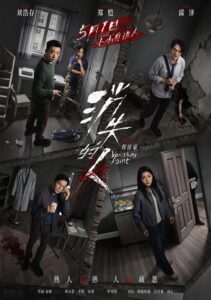 STORY
A city somewhere in Sichuan province, southwest China, 19 Dec 2024. In debt to a gambling house to the tune of RMB60,000, and put on notice by its boss (Li Meng), gambler Yan Wu (Qiu Ze) returns home to Flat 301, Qinglan Gardens housing estate, which he shares with his retired father (Zhang Qi). The flat’s owner, Lin Yutong (Liu Haocun), who has come to collect the monthly rent, is just leaving. Yan Wu tries to borrow more money from his father, who realises it’s for gambling debts and refuses. Following a heated argument, the father has a heart attack and dies. Among his father’s belongings Yan Wu finds a bundle of cash in an envelope. Two days later, early in the morning of the shortest day of the year, Tang Yu (Zheng Kai), who lives in Flat 402, a floor above the Yans, brings his car round to take his nine-year-old son, Tang Nuo (Tang Xinyi), to school. The boy suffers from ADHD and is difficult to get on with. Between saying goodbye to his mother (Jiang Yan) and the entrance to the building, Tang Nuo disappears. Tang Yu visits Flat 302, where Xu Yingying (Feng Xueya), a young girl who’d befriended Tang Nuo lives, but no one answers the door. A police officer, Fang Min (Huang Xiaolei), and her colleague Sun Hui (Kukude Teng), check the estate’s limited CCTV but find no proof that Tang Nuo ever left the building. When Xu Yingying arrives to collect a schoolbook she forgot, the police are able to search Flat 302 but find it empty. However, Fang Min does find a speck of blood on a doorframe, which she collects for testing. (Two nights earlier, Xu Yingying had watched from the street as Lin Yutong left the estate after visiting the Yans and was picked up by her elder brother, Lin Wenzhao [Li Chen], a hospital doctor who was still concerned about her well-being. In the car she had told him she still wanted to find out “who it was”, even though it wouldn’t change anything.) (Six months earlier, still limping from a car accident, Lin Yutong had been dropped off at the flat she owned – Flat 301 in Qinglan Gardens – by Jun [Bi Wenjun], a work colleague. Lin Wenzhao, who had been waiting for her with some milk and honey he’d brought, had noticed how Jun was still hanging around outside, nervously smoking. He’d suggested it was because Jun fancied her, though she had said Jun had never given any hint of that. During the night Li Wentong had been drugged and raped by an intruder.) Yan Wu has lost all the money he found at home. Meanwhile, two hours after Tang Nuo’s disappearance, his mother thinks her son has been kidnapped. (Six months earlier, Tang Yu and Tang Nuo had come across Xu Yingying on the stairwell, locked out of Flat 302, and had invited her in until her father returned. The two kids had bonded, though Tang Nuo’s mother hadn’t approved.) Lin Wenzhao suspects it was Jun who climbed up a pipe and drugged and raped her that night. He asks Lin Yutong to get one of Jun’s cigarette butts so he can have it DNA tested. She manages to do so, and when Jun clumsily tries to ask her out after work she runs off. Meanwile, Yan Wu takes his father’s savings book and ID card so he can carry on claiming his pension. His father’s corpse is already smelling badly and, after fantasising about hacking it up in order to dispose of it, Yan Wu gets the idea of embalming it. Meanwhile, Tang Yu finds a note in Tang Nuo’s bag saying he will use Xu Yingying’s spare key to stay in Flat 302 until she comes back. Tang Yu’s wife, who’s been examining police CCTV, says Xu Yingying never went to school that day, instead taking a bus to the suburbs. Meanwhile, Yan Wu takes a bus into the suburbs to buy some tiles so he can wall up his father’s embalmed corpse in the flat. The shop owner happens to be Xu Yingying’s father, Xu Zhijie (Feng Bing), who says he lives nearby and drives Yan Wu and his tiles back. Tang Yu tracks Xu Yingying to a park where he and his family happened to have stayed last summer. Xu Yingying confesses to him that she and Tang Nuo had made a pact to meet in Flat 302, but when she came back he wasn’t there, so she thought he’d maybe gone to the guesthouse in the park. Meanwhile, police officer Fang Min hears the blood sample she took in Flat 302 was from a human, so Tang Nuo’s disappearance is now being treated as a criminal case.
REVIEW
A multi-layerel mystery-cum-whodunit that gradually merges three, seemingly separate stories, Vanishing Point 消失的人 starts gangbusters but frustratingly starts going off the rails from the midpoint on. High on production values but undercut by increasingly tortuous plotting, editing that seems designed to confuse, and some very obvious jumps of logic, this sixth feature by Taiwan film-maker Cheng Weihao 程伟豪, 42, looks in its first hour to be on a level with his best movie to date, the complex and absorbing whydunit Who Killed Cock Robin 目击者 (2017), but ends up more like his worst, the futuristic whodunit The Soul 缉魂 (2021). Mainland financed and shot, but with several Taiwanese on staff (creative producer 监制 Jin Bailun 金百伦, plus editor, composer and visual effects), it took a nice RMB575 million on May Day release and became a hotly-debated talking point for a while.
Even when their scripts are not up to scratch, Cheng’s films have always had a stylish look – right from his first feature, the modestly budgeted but atmospheric Taiwan horror The Tag-Along 红衣小女孩 (2015). On all four of his Taiwan features to date, he’s used local d.p. Chen Qiwen 陈麒文; on Vanishing Point (his first all-Mainland-funded production), as on The Soul (a China-Taiwan-Hong Kong production), he’s used a non-Taiwan cameraman, in this case Hong Kong’s Zhang Yuhan 张宇瀚, aka Liuxing 流星 (“Meteor”) (Table for Six 饭戏攻心, 2022; Time Still Turns the Pages 年少日记, 2023; The Furious 火遮眼, 2025). Zhang’s not notable for any particular style but here turns in some striking widescreen photography of cityscapes and blocks of flats that is a major contributor to the film’s dystopian atmosphere – painting an urban forest of geometrical, soulless buildings that 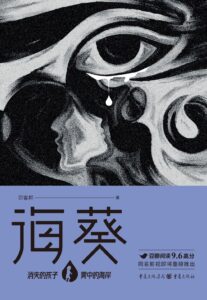 carry their own sense of threat. (Some 80% of the film was shot in Yongchuan, a district in the west of the giant municipality of Chongqing, central China.)
Though it changes all the characters’ names and has a strongly Sichuanese sense of place, Cheng’s screenplay is fairly closely based on a 2019 online serialised novel, Sea Anemone 海葵, by Zhejiang-born mystery writer Bei Kebang 贝客邦, pen name of Wang Xiaodong 王晓栋, 45 (see cover of 2021 book edition, left). The 300-page novel was already adapted into a classy 12-part TV drama, 消失的孩子 (literally, “The Disappearing Child”), broadcast in 2022, starring the actors Tong Dawei 佟大为 and Wei Chen 魏晨, and directed by the brothers Zhao Xiao’ou 赵小鸥 and Zhao Xiaoxi 赵小溪 (see poster, below left). Vanishing Point’s first hour is top class, as the various characters and (apparently) separate storylines are introduced: compulsive gambler Yan Wu (Taiwan actor-singer Qiu Ze 邱泽), who’s RMB60,000 in debt and lives entirely off the pension of his retired father (Zhang Qi 张琪); Lin Yutong (actress Liu Haocun 刘浩存), 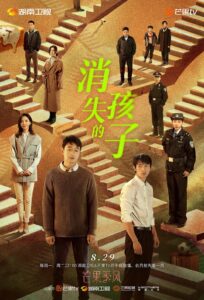 young owner of the flat they rent and the younger sister of an over-protective hospital doctor (Li Chen 李晨); Tang Yu (Zheng Kai 郑恺), father of a nine-year-old son with ADHD and husband of a naggy, over-strung wife (TV actress Jiang Yan 姜妍, looking permanently distressed); and Xu Zhijie (Feng Bing 冯兵), owner of a tile shop in the suburbs and father of a young girl who’s befriended Tang Yu’s troublesome son. All, except Lin Yutong and her brother, live on the same staircase in a housing estate’s apartment block.
As the film begins, Yan Wu has a major argument with his father, who’s fed up with bailing his son out and promptly has a heart attack. In a panic, the penniless Yan Wu decides not to report the death so he can carry on drawing his father’s pension. But the event that starts to tie the stories together happens two days later, on the Winter Solstice, when Tang Yu is waiting downstairs to drive his son to school and the boy never appears. The estate’s limited CCTV shows the boy never left the building, so must have vanished somewhere on the stairwell between the family’s flat and the main entrance. Tang Yu’s first thought is that his son visited Xu Zhijie’s daughter in the flat below, but no one is at home; when the girl suddenly shows up to collect a book she forgot, a search of the flat by Tang Yu and two police shows it to be empty, though the policewoman in charge (Huang Xiaolei 黄小蕾) finds a drop of blood on a door jam.
This opening 20 minutes is compulsively watchable, aided by strong but unshowy performances by a name cast, the vaguely ominous widescreen imagery, and the whole locked room-type mystery of how the boy vanished into thin air. As the film then flashes back to Lin Yutong leaving the flat of Yan Wu and his father, after dropping by for the rent, the film’s basic theme of “skeletons lurking behind each closed door” (in the policewoman’s words) starts building with a vengeance: she’s picked up by her over-possessive brother, whom she tells she still wants to find out “who it was”, even though “it won’t change anything”. The event, we immediately learn in a flashback to six months earlier, was her rape (after being drugged in her sleep) in the flat she later rented out to Yan Wu and his father.
Scarcely half-and-hour into the movie, the main goalposts have been established. More flashbacks fill in background (such as the friendship between Tang Yu’s son and Xu Zhijie’s daughter) alongside the developing stories of the boy’s disappearance, the suspicion that Lin Yutong’s rapist may have been a young office colleague who secretly fancied her, and Yan Wu’s problem of what to do with his father’s now-pungent corpse. The last plotline is the first to stretch credibility a little, as Yan Wu decides to wall the corpse up in the flat and goes to buy some tiles in the suburbs – where he just happens to visit the shop of Xu Zhijie (whom he doesn’t recognise). Meanwhile, Tang Yu discovers that the story of Xu Zhijie’s daughter doesn’t quite add up, and tracks her down to a surburban park where he and the family just happened to stay last summer.
During the following hour, the carefully constructed atmosphere of the exposition is gradually fragmented by more and more unlikely coincidences and irrational actions, frequently misleading editing, as well as a slow detachment from the original set-up. For instance, Yan Wu’s gambling subplot, in which he was put on notice by the tough boss of the gambling house (always interesting actress Li Meng 李梦, in a flavoursome bit part), is dropped; the choppy marriage between Tang Yu and his over-strung wife is parked in the background; and nothing extra is made of the disappearance taking place on the shortest day of the year. To its credit, the film does come up with several red herrings as to the identity of the villain that largely manage to sustain the second half as the plotting becomes increasingly labyrinthine and clogged with detail. The biggest weakness, however, is the film’s lack of screen geography – something on which any understanding of the final solution strongly depends. Vanishing Point is never less than visually interesting, even when the screenplay is tying itself in knots, but Cheng forgets that the viewer needs a sense of where locations are in relation to each other to get the most from the mystery.
Performances are strong down the line, even though the adoption by some actors of a Sichuan accent may seem jolting for those who know them well. Shanghai-born Zheng, here in serious mode for a change, is excellent as the father who normally avoids conflict; Taiwan’s Qiu is almost unrecognisable playing scruffily against type as the obsessive gambler; Liu (so good in One Second 一秒钟, 2020, and A Little Red Flower 送你一朵小红花, 2020) doesn’t have so much to work with but is a sympathetic screen presence; ditto the always reliable Li (MBA Partners 梦想合伙人, 2016; Sky Hunter 空天猎, 2017; Where Nothing Grows 荒原, 2022) as her suspiciously intrusive elder brother; while Feng (the eccentric biker in Upstream 逆行人生, 2024) is very good as the tile seller who lives downstairs, a role that, unlike most of the others, actually develops throughout the film. Among the supports, the tireless and always watchable Huang is notable as the determined policewoman at the centre of the investigation.
Shooting took place over two months, from Oct-Dec 2024. The film’s Chinese title literally means “The Disappearing Person”.
CREDITS
Presented by QC Media (Wuxi) (CN), Tianjin Maoyan Weiying Cultural Media (CN), Horgos Jiangwan Film (CN), Beijing QC Media (CN).
Script: Cheng Weihao. Novel: Bei Kebang. Photography: Liuxing [Zhang Yuhan]. Editing: Zhang Kaizhu. Music: Liu Jiakai. Art direction: Lu Wei. Costume design: Shi Ruina, Zhao Han. Costumes: Song Xinying. Styling: Tang Ning. Sound: Zhang Junchuan, Wang Yanwei. Action: Hu Lifeng, Wang Lei. Visual effects: Liu Weiyi (Illusion Studio). Executive direction: Lai Zijun.
Cast: Zheng Kai (Tang Yu), Liu Haocun (Lin Yutong), Qiu Ze (Yan Wu), Li Chen (Lin Wenzhao, Lin Yutong’s elder brother), Jiang Yan (Yu, Tang Yu’s wife), Huang Xiaolei (Fang Min, police officer), Li Meng (Li Xiaohong, gambling-house boss), Zhang Qi (Yan Wu’s father), Bi Wenjun (Jun, Lin Yutong’s office colleague), Feng Bing (Xu Zhijie), Kukude Teng [Teng Zhe] (Sun Hui, Fang Min’s police colleague), Tang Xinyi (Tang Nuo, Tang Yu’s son), Feng Xueya (Xu Yingying, Xu Zhijie’s daughter), Lv Ning (Li, police captain), Wang Luqing (Xiaoqing, Lin Yutong’s office colleague), Liu Xingjie (Zhang Heng, DNA tester).
Release: China, 1 May 2026.