The Volunteers: Peace at Last
志愿军 第三部 浴血和平
China, 2025, colour, 2.35:1, 145 mins.
Director: Chen Kaige 陈凯歌.
Rating: 5/10.
A rather low-key, dramatically disjointed wrap-up to the Korean War trilogy that’s okay but not on a level demanded by the whole enterprise.
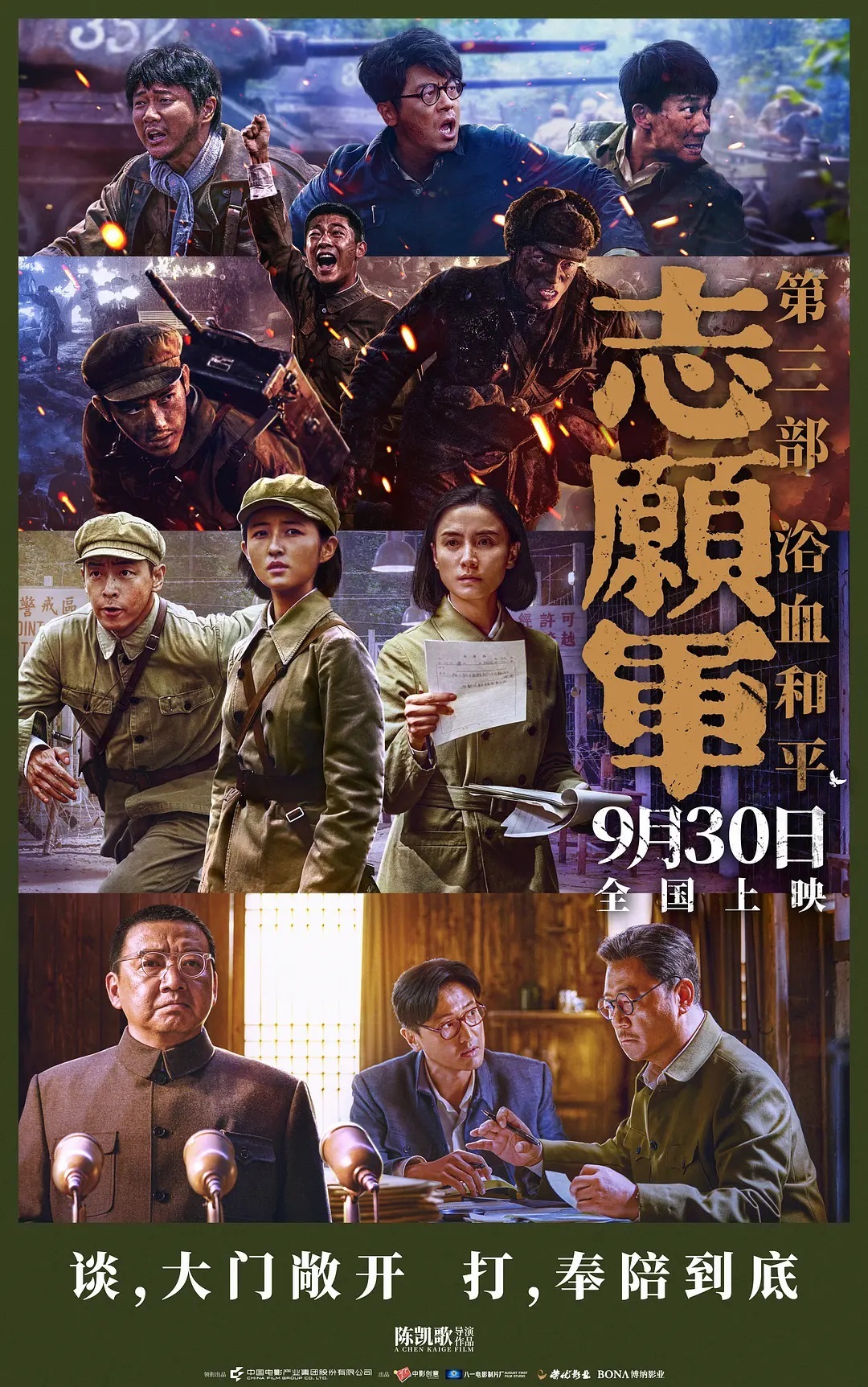 STORY
STORY
North Korea, Kaeseong, early Jul 1951. Under the ceasefire agreed between China and the US, the CPC Central Committee and Chairman Mao arrange for Foreign Ministry deputy head Li Ke’nong (Guo Tao) to secretly enter North Korea to monitor negotiations. English interpreter Li Xiao (Zhang Zifeng) arrives by train at the People’s Volunteer Army logistics depot and meets her friend Yang Sandi (Zhang Youhao), who used to be a casualty recorder but is now part of the division’s publicity team. He tells Li Xiao that the remains of her father, Li Moyin (Xin Baiqing), have not so far been found, so there is still hope that he is alive. Li Xiao, who is still very angry over the death of her elder brother Li Xiang (Zhu Yilong) at the hands of the Americans, is driven to where the negotiations are to take place and meets Lin Yueming (Song Jia), head of the translating team. Next day, international journalists and the delegation representing the “United Nations Forces” (i.e. the US and South Korea) arrive. Delegation head C. Turner Joy (Michael J. Rosenthal), a US vice-admiral, orders the US helicopter to deliberately land on top of a dove of peace outlined with white stones on the ground. Negotiations start at 10:00 on 10 Jul; but the US delegates are so arrogant and dismissive of protocol, simply trying to get the Chinese/North Korean side to sign a surrender, that they walk out when they fail in their objective. at the end of the session Lin Yueming has an attack of stomach pains that Li Xiao helps her with. The Americans then try to provoke the Chinese and North Koreans to call off the negotiations by attacking their troops in Pungcheon-ri Heights, very close to where the talks are being held, as a demonstration of their military superiority. However, Li Ke’nong secretly tells the Chinese/North Korean delegation not to react. PVA commander Peng Dehuai (Wang Yanhui) orders Pungcheon-ri Heights to be retaken as soon as possible. In a messy night battle this is done, but PVA deputy commander Sun Xing (Chen Feiyu) is shot in the back by Bull (Vander McLeod), a US major, after chasing him into the neutral zone. The news deeply affects Li Xiao, who was a friend of Sun Xing from his days as an army scout. The Americans keep trying to provoke the Chinese into breaking the terms of the ceasefire, but the Chinese hold firm, even at the cost of Chinese lives, including Yao Qingxiang (Peng Yuchang), head of delegations security, shot in Aug 1951 in an assassination authorised by Matthew B. Ridgway (Andrew Rolfe), UN Forces supreme commander. Lin Yueming becomes increasingly angry and has a bad attack of her stomach pains – due to gastric ulcers that may now be cancerous. On 23 Aug 1951 the CPC’s Central Committee decides to suspend negotiations with the Americans. On the battlefield UN Forces are not successful, so on 25 Oct 1951 they are forced to return to the negotiating table, this time in nearby Panmunjeom. The Americans make ridiculous demands that are rejected, and then start bombing with bacterial munitions that cause outbreaks of plague and other illnesses. Finally, in Oct 1952 a new chief negotiator, US general William K. Harrison (Vincent Matile), takes over, only to declare an “indefinite recess”. This is a clear message that the “UN Forces” want only a military, not a negotiated, solution. In mid-Oct 1952 both sides meet at Sangamryeong by Mount Oseongsan, in a bloody confrontation known as the Battle of Triangle Hill. But the war’s final military campaign is not until the following summer, in a tank battle at Kamseong. A peace agreement is finally signed at Panmunjeom on 27 Jul 1953 by North Korean general Nam Il (Yu Qingbin) and William K. Harrison. Peng Dehuai gives a rousing speech that the days of western aggression are over.
REVIEW
It would be nice to report that the final part of the Korean War trilogy directed and masterminded by veteran Chen Kaige 陈凯歌 is a dramatically satisfying conclusion to the whole enterprise. In fact, The Volunteers: Peace at Last 志愿军 第三部 浴血和平 is more a low-key wrap-up to the family story begun in the second segment, The Volunteers: The Battle of Life and Death 志愿军 第二部 存亡之战 (2024), decked out with several visceral battle sequences inbetween the endless attempts by the Chinese and North Koreans to negotiate with the arrogant Americans. Its 140-odd minutes (similar to the previous parts) are in no way a hard sit thanks to several well-drawn characters; but the whole film lacks a dramatic arch and emerges more as a series of moments, capped by an unnecessary coda set in the present day. Released like the other two parts in September, it was the weakest performer in the trilogy, taking only a solid RMB642 million, around half of The Battle of Life and Death’s hawl.
After a recap of past events, the film proper opens in Jul 1951 in Kaeseong, where both sides (the Chinese/North Koreans and the Americans/South Koreans) meet to negotiate under the ceasefire arranged by both sides. The Chinese use the name “The Chinese People’s Volunteer Army” and the Americans the name “UN Forces” to disguise the fact the two countries are really at war with each other. And in the background on the Chinee side is Li Ke’nong, deputy Foreign Minister, sent by the CPC’s Central Committe and Chairman Mao to secretly advise on negotiations. Observing all this subterfuge is Li Xiao, whose story the audience has been following since the last film: a PVA English interpreter, she’s been sent to join the team at Kaeseong and has already lost her elder brother and probably her father in the war. She’d rather be at the front killing Americans, but is persuaded to stay by chief interpreter Lin Yueming, in a developing female friendship that is to sustain a lot of the movie.
Peace at Last initially looks like centring on the whole public theatre of the peace negotiations – which in reality went on for months and months, largely pointlessly, and could easily take up a whole film. But Chen and the trilogy’s regular writer Zhang Ke 张珂 – here joined by Zhao Ningyu 赵宁宇, known for flag-wavers like Towards the River Glorious 打过长江去 (2019), The Sacrifice 金刚川 (2020), and 1921 1921 (2021) – portray the American delegates as so arrogant, racist and dismissive of basic protocol that this never develops into a believable or involving plot strand. These leering, pantomime figures go far beyond the portrayal of Americans in the previous two parts.
Li Xiao’s own plot strand is much more believable but only fitfully involving, with outbursts of despair as one after another colleague is killed, frosty looks at the swaggering Americans, or expressions of concern at her boss’ illness. The modern-day coda attempts to bring closure to Li Xiao’s story but it’s a hackneyed device and far from the actual war in which her passions were engaged. Between all these dramatic fragments – and copious intertitles describing the passage of events – lie the battle sequences, which are powerfuly staged, with relatively little use of VFX compared with the norm nowadays, and centred, like the whole trilogy, on individual characters rather than just big explosions and lots of gunfire. The last major setpiece, lasting some 20 minutes and showing the bloodbath of the Battle of Triangle Hill in autumn 1952, is especially impressive with some inspiring moments, even if, like the other big setpieces in the trilogy, those moments are very filmy. Unfortunately, Chen & Co. push their luck by following that with yet another battle, this time with tanks nine months later, which pales in comparison. The film also reveals its modern bias with some jarring (and ahistorical) anti-smoking propaganda.
Though much of the dialogue the cast is given is platitudinous on the subject of peace vs war, everyone performs strongly at every level, with several characters from the previous movies popping up again and big-name cameos (such as Xiao Yang 肖央 as a supplies driver) not seeming too look-at-me. Among those giving the most passionate delivery are top-billed Zhang Zifeng 张子枫 (as the grouchy, pushy Li Xiao), the always impressive Song Jia 宋佳 (in a rare leading role as the principled chief interpreter), Guo Tao 郭涛 (in a straight performance as the secret Foreign Ministry advisor) and TV actor Wu Haochen 吴昊宸 (as a smiley, opportunistic soldier who reforms himself). In a film that could almost be describing events and attitudes of the present day, a final speech by PVA commander Peng Dehuai that the days of western aggression are now over has an ironic ring that may or may not be deliberate on the part of the writers.
The film’s Chinese title means “The Volunteer Army Part Three Bloodbath Peace”. The whole trilogy runs 427 minutes and took a combined RMB2.72 billion.
CREDITS
Presented by China Film Creative (Beijing) Film (CN), China Film (CN), August First Film Studio (CN), Beijing Rongyou Film & TV Culture Media (CN), Beijing Bona Film Group (CN). Produced by Beijing Rongyou Film & TV Culture Media (CN).
Script: Chen Kaige, Zhang Ke, Zhao Ningyu. Photography: Zhao Fei. Aerial photography: Guo Chen. Editing: Li Ruiliang. Music: Guo Sida. Music advice: Liao Jiawei. Art direction: Lu Wei. Costumes: Song Fengru. Styling: Chen Tongxun. Sound: Wang Danrong. Action: Sun Nuo. Visual effects: Wang Lei. Military affairs direction: Li Ang. Executive direction: Lin Jie, Chen Feihong, Chu Wenming.
Cast: Zhang Zifeng (Li Xiao, English interpreter), Song Jia (Lin Yueming, delegation chief interpreter), Zhu Yawen (Wu Benzheng, military scholar), Chen Feiyu (Sun Xing, PVA deputy commander), Peng Yuchang (Yao Qingxiang, delegations security head), Xiao Yang (Zhao Annan, driver), Wang Yanhui (Peng Dehuai, Northwest Military Area commander/People’s Volunteer Army commander), Guo Tao (Li Ke’nong, Foreign Ministry deputy head), Wang Chuanjun (Qiao Guanhua, delegation advisor), Zhou Zhengjie (Huang Jiguang, comms), Zhang Youhao (Yang Sandi, People’s Volunteer Army casualty recorder/photographer), Wu Haochen (Zhang Xiaowen, 47th Army 139th Division soldier, younger brother of Zhang Xiaoheng), Wang Ting (Deng Hua, People’s Volunteer Army deputy commander/delegate), Guo Xiaotong (Xie Fang, People’s Volunteer Army chief of staff/delegate), Li Chen (Qin Jiwei, 15th Army commander), Du Jiang (Cui Jiangong, comms), Feng Shaofeng (Lin Fabao, tank commander), Yan Ni (Yan, hospital doctor), Aruna (Qian, company commander), Qu He (Zhang Juan, hospital nurse), Wang Yutian (Shi Guangming, railway-army head), Yu Jinwei (Bian Zhangwu, delegate), Wang Yang (Long Daoquan, 63rd Army political instructor), Zhang Xueying (Xi’er), Danny Ray [Dmitrijs Rezanovics] (US pilot prisoner), Liu Jun (old Li Xiao), Zhu Yilong (Li Xiang, Li Xiao’s elder brother), Xin Baiqing (Li Moyin, Li Xiao’s father), Yuan Kai (Zhang Guangsheng, staff officer), Liang Jingkang (Wan Fulai, soldier), Yu Qingbin (Nam Il, North Korean general/chief negotiator), Liu Xu (Yang Ding, tank-school head), Vander McLeod (Bull, US major), Vincent Matile (William K. Harrison, US general/UN Forces delegation head, Oct 1952), Andrew Rolfe (Matthew B. Ridgway, UN Forces supreme commander), Kevin Clyne (Laurence C. Craigie, US major-general/UN Forces delegation member, Jul 1951), Michael J. Rosenthal (C. Turner Joy, US vice-admiral/UN Forces delegation head, Jul 1951).
Release: China, 30 Sep 2025.