Hey, Houlai
夏雨来
China, 2025, colour, 2.35:1, 107 mins.
Director: Yang Qingxi 杨清希.
Rating: 6/10.
Traditional village comedy, played in the Chaoshan [Teochew] dialect and centred on a crafty but well-meaning scholar, is well-tooled but nothing new.
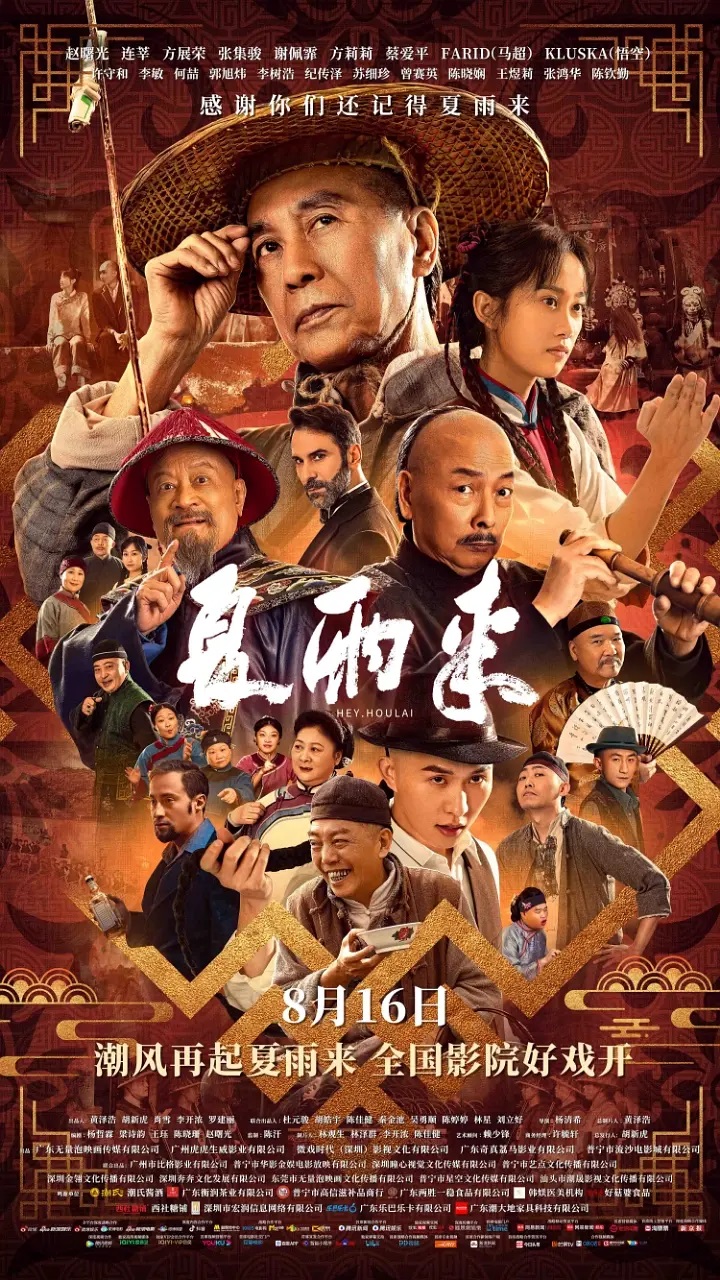 STORY
STORY
Longhu village, eastern Guangdong province, southern China, late Qing dynasty. At the celebrations for the opening of a new family business in the village, Xia Yulai (Zhao Shuguang), a veteran county-level scholar 秀才, is chosen by county magistrate Fang (Fang Zhanrong) to have the honour of dotting the eyes of the dragon paid for by the Jin family. Meanwhile, Xia Yulai’s rebellious tomboy daughter, Xia Laibi (Xie Peifei), gets into an argument with Jin Liangkun (Zhang Jijun), an arrogant young member of the Jin family who’s just returned from studying abroad, and accidentally damages the dragon’s nose. Xia Laibi souldn’t even have been at the feast at the same time as Jin Liangkun, as village tradition dictated that the women could only eat when the men had finished – a rule she deliberately ignored. To smooth things over, Xia Yulai passes his role over to Jin Liangkun’s pompous father, Jin Xiuxian (Lian Shen), who is delighted. That night, in front of the puppet theatre operated by Xia Yulai’s elder sister Xia Chunhua (Fang Lili), local businessman Liu Shi (Cai Aiping) harasses her assistant, Guo Ya (Wang Yuli), with whom he has a marriage contract. The contract was agreed to by Guo Ya’s elder brother in lieu of monies he borrowed from Liu Shi to pay off his gambling debts; Guo Ya had no say in the matter. Xia Laibi fights off Liu Shi’s men and Liu Shi threatens to sue. To defuse the situation, Xia Yulai recommends that Jin Xiuxian adjudicates the matter; he also bluffs Liu Shi into deciding not to marry Guo Ya as she brings bad luck. Meanwhile, Jin Liangkun, who genuinely likes Xia Laibi, tries to flirt with her, but she continues to brush him off. Next, Guo Ya’s father (Xu Shouhe) receives an IOU from Liu Shi for the 200 taels of silver owed by his son. As the Guo family is illiterate, Xia Yulai is called in to inspect the document, and he suspects – as Liu Shi is illiterate too – that the IOU was actually written by a foreign businessman, Simon (Ma Chao), who’s recently arrived in the village and set up the Ailai’er Cloth Shop to undercut locals. Just in time, Guo Ya and her father and mother (Li Min) manage to flee the village by boat. After an argument with his father, Jin Liangkun goes to stay at the home of Xia Yulai, much to the annoyance of Xia Laibi. She’s trying to teach herself to be a lawyer but he won’t stop flirting with her. At a traditional dragon-boat race between the Xia and Jin families, Simon uses opium to stir up anger between the two teams, and soon the whole village is fighting. Xia Yulai is knocked out and falls into a coma. He recovers just in time to prevent Jin Xiuxian, who’s gone bankrupt due to Simon’s business activities, from publically hanging himself. However, Simon has won over most of the village by providing free food and (apparently) adopting abandoned children. Smelling something fishy, Xia Yulai goes to see Simon and his associate Deaton. That night, while Xia Yulai is having dinner with them, Xia Laibi clandestinely enters the building to photograph evidence of the foreigners’ activities; but she ends up being caught and accused of Deaton’s murder.
REVIEW
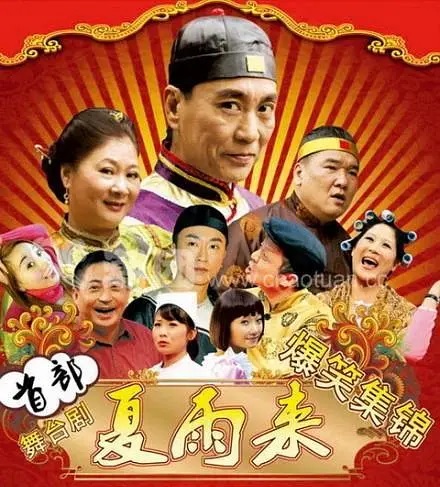 Legendary local character Xia Yulai is revived on the big screen in Hey, Houlai 夏雨来, the first feature entirely in the Chaoshan (aka Teochew) dialect to get a commercial release in China. It’s also a revival in another sense – bringing back to the screen actor-writer-director Zhao Shuguang 赵曙光, now 71, who first created the role in a series of 1990s TV sitcoms (see poster, left) that were also a first for the Chaoshan dialect. Leaving aside all its cultural niceties, the film is hardly anything special – an old-fashioned village comedy, set during the late Qing dynasty, centred on an unconventional scholar who sorts out local conflicts with a mixture of guile and righteousness. Despite a plot that’s very manufactured, performances are good down the line (bringing back several other actors from the TV series) and technically the production is always good-looking and smoothly assembled. Given its specialised appeal, the modest box-office of RMB28 million this summer was pretty decent.
The culture of Chaoshan – a word combining the names of the region’s two main cities, Chaozhou and Shantou – is very different from Cantonese culture, despite coming from the same province of Guangdong, just across from Hong Kong in southern China. Chaoshan is right up against the southern coastal border of Fujian province, and its local dialect is very similar to the minnanhua 闽南话 dialect (aka Hokkien) spoken in southern Fujian (and in Taiwan opposite). Zhao was actually born in the northern province of Hebei, but in 1971 he joined the Shantou Song & Dance Troupe to study dance. Due to an injury he switched to acting in 1979 and later headed the troupe before moving to another group. Working as an actor, writer and co-director (with Yang Denglong 杨登隆), from 1991 he created the series of Chaoshan-dialect TV sitcoms centred on Xia Yulai, a character supposedly based on a real-life inhabitant of Longhu village during the Qing dynasty (though some claim other dynasties).
Wordplay makes up a significant amount of the humour in the film, especially in the village celebrations at the start, though for non-Chinese speakers it’s not a huge obstacle. Performances are broad and jokes are clearly labelled with farce-like facial expressions: Xia Yulai the unconventional village wise man, Xia Laibi his unconventional tomboy daughter, Jin Liangkun the foreign-educated rich kid, Liu Shi the stupid local heavy, Fang the dim county magistrate – all broad comic stereotypes in a period, costume setting. The film’s themes also dovetail with them: the hero challenging imperial norms, the daughter challenging social norms, the rich kid signalling China’s gradual opening up, as well as the opium-carrying western villains (not too subtly) repping foreign exploitation.
Zhao doesn’t dominate the film as one might expect, and manages to make the character seem fresh and likeable despite being his umpteenth go at it. Newcomer Xie Peifei 谢佩霏 is especially good as the arse-kicking, tomboyish daughter who constantly challenges sexual norms, while boybander Zhang Jijun 张集骏 is a good match as her battered suitor. Zhao’s real-life wife, Fang Lili 方莉莉, returns as Xia Yulai’s feisty elder sister who runs a puppet theatre.
Under the direction of the young Yang Qingxi 杨清希, who previously made the Shenzhen-set music drama Under the City’s Tree 深城树下 (2023), it’s all good-hearted fun, beautifully shot in rich colours (by d.p. Lei Xiong 雷雄), authentically styled (by Xia Hai’ou 夏海欧) and carefully staged in Longhu village (now a tourist site) itself. Editing by Kong Yapeng 孔亚鹏 is particularly smooth, and traditional Chinese scoring well placed. At 107 minutes the whole thing is about 15 minutes too long for such an episodic narrative, with the climactic trial scene, which starts at the 74-minute mark, a candidate for tightening, despite its several twists. In all, the film took four years to reach the screen; filming started in late Dec 2022.
For the record, in Chaoshan dialect the hero’s given name (“Yulai” in Mandarin) is pronounced “Houlai”, which also sounds like the word for “fox”, further underlining his crafty nature (though always in a good cause). As a further linguistic wrinkle, Xia Yulai, if read as “Xia Yu Lai” rather than as a name, literally means “Summer Rain Comes”. And a running joke throughout is transliterating foreign villain Simon’s name as 屎慢 (pronounced “sai-man” in Chaoshan dialect), which literally means “Shit Slow”.
CREDITS
Presented by Guangdong Unlimited Bubbles Visual Media Culture Studio (CN), Guangzhou Tiger Pictures Film (CN), Media Dreams Era (Shenzhen) Film & TV Culture (CN), Guangdong Qizhen Lima Film (CN), Puning City Liusha Cinema City (CN).
Script: Yang Zhelin, Liang Shiyun, Chen Xiaoshan, Wang Jue, Zhao Shuguang. Photography: Lei Xiong. Editing: Kong Yapeng. Music: A Nao. Title song: Li Weiwen (music), Cai Shubiao (lyrics). Art direction: Zhu Zhenglai. Costumes: Li Lian. Styling: Xia Hai’ou. Sound: Chen Mengchun, Zhang Yuhong. Action: Lin Jiang. Visual effects: Da Wei. Artistic advice: Lai Shaofeng.
Cast: Zhao Shuguang (Xia Yulai), Lian Shen (Jin Xiuxian), Fang Zhanrong (Fang, county magistrate), Zhang Jijun (Jin Liangkun), Xie Peifei (Xia Laibi), Fang Lili (Xia Chunhua), Cai Aiping (Liu Shi), Xu Shouhe (Guo Ya’s father), Li Min (Guo Ya’s mother), Ma Chao (Simon), Wu Kong (Deaton), He Zhe (Chou Zui/Stinky Mouth, Jin Liangkun’s pal), Huo Xuwei (Lang Mian/Wave Face, Jin Liangkun’s pal), Li Shuhao (Ji Ge/Chicken Brother), Ji Chuanze (Jin Zhuge), Zeng Saiying (Jin Ping), Su Xizhen (Jin Feng), Chen Xiaoxian (Jin Ye), Wang Yuli (Guo Ya), Zhang Honghua (Fang’s attendant), Chen Qinqin.
Release: China, 16 Aug 2025.