Good Luck
好运来
China, 2024, colour, 2.35:1, 99 mins.
Director: Zhu Lingfeng 朱凌锋.
Rating: 4/10.
Routinely scripted, episodic comedy about three losers helped to realise their dreams just about scrapes through on name power.
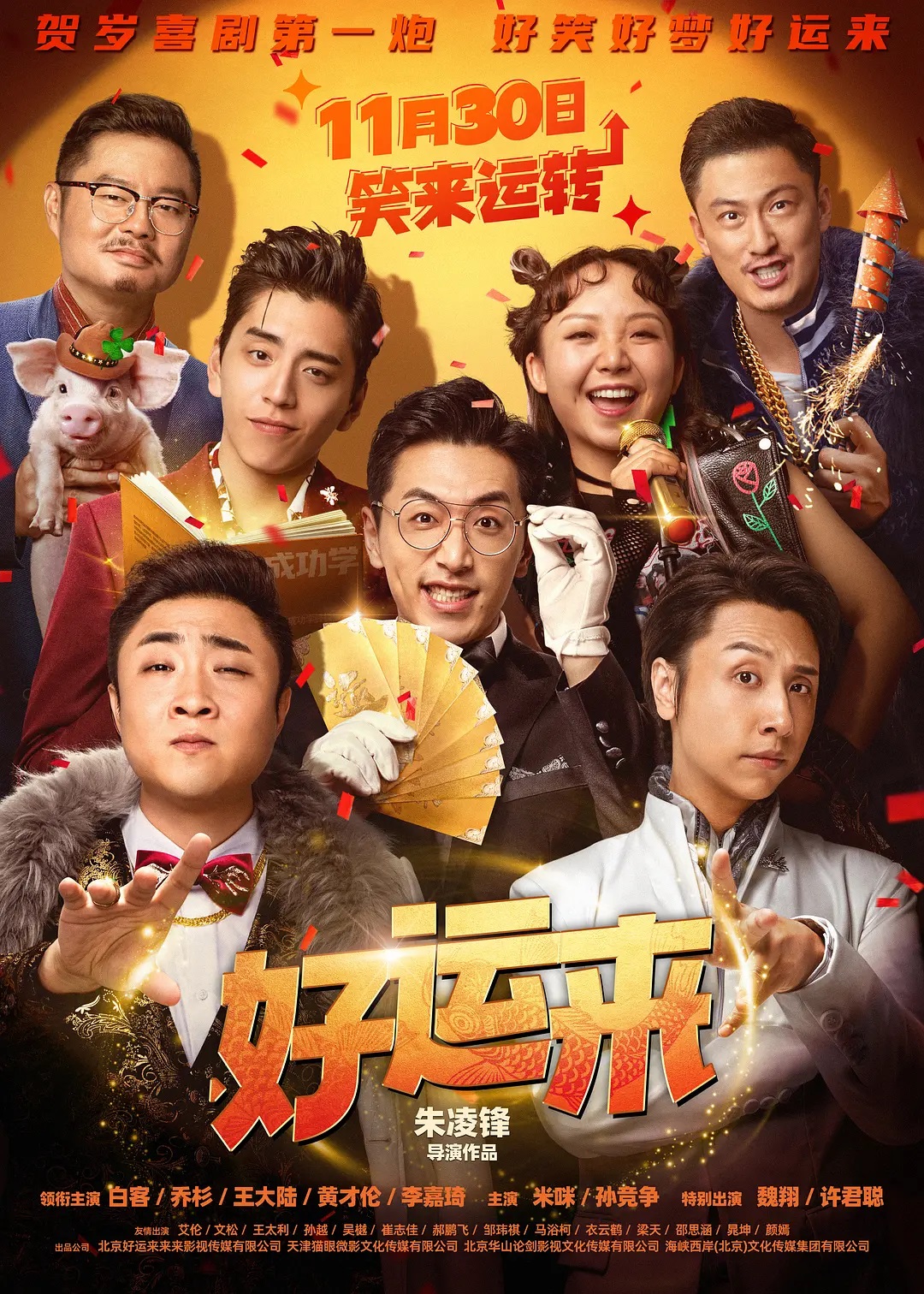 STORY
STORY
Binhai, northern China, the present day. At a wedding-like ceremony in a modern church, Yao Xiaofeng (Bai Ke), founder of Good Luck Company but a poor manager, hands over the position of CEO to Jia Ling (Huang Cailun). As part of his aggressive new policy, Jia Ling officially launches a new scheme to help people realise their dreams. From all the applicants’ files, Jia Ling randomly selects that of Zhao Qingchen (Li Jiaqi), a feisty street busker who wants to become famous. Jia Ling outlines a three-day plan to turn her into a singing superstar: on the first day she’ll win a talent show and on the final day she’ll walk a red carpet and win the Best Newcomer Award. Everything is faked, with the staff of four playing various parts; but Zhao Qingchen goes through with it to make her terminally ill father happy. The next client is Lun (Wang Dalu), an artist who has always dreamed of becoming a successful entrepreneur. His girlfriend (Xiong Xin) asks Good Luck Company to help him sort himself out. They install him in a luxury hotel suite with his private staff, and arrange a private yacht with beautiful girl, to make him feel important and increase his self-confidence. Finally, Lun realises what is his true vocation. The third client is a food delivery man, Qiao Xiaoshan (Qiao Shan), who’s down on his luck and hasn’t been back to his home village for Chinese New Year in five or six years. Good Luck Company arranges for him to go back in a Rolls-Royce, visibly successful, with his own staff. However, when they arrive, they find several other successful villagers are also being greeted by village head Jia (Wei Xiang) and he finds himself competing for attention with them – especially Da Cong (Xu Juncong) – for face. Qiao Xiaoshan’s father, a farmer, spurns him and all his big-city success; and his fourth aunt says she’s arranged a local bride for him.
REVIEW
A small company of four solves people’s dreams and helps them realise their ambitions in Good Luck 好运来, an episodic comedy stuffed with Mainland pranksters that has a familiar ring about it. The first major theatrical feature by Beijing-born writer-director Zhu Lingfeng 朱凌锋, 41, a former publicity manager who’s been active as a film-maker during the past decade mostly online and in TVDs, it just about scrapes through on accumulated name power and glossy production values. However, everyone here has been seen to much better effect elsewhere, and the script is routine, finally striking some sparks in the final segment but never going beyond the obvious. Box office late last year was a blah RMB63 million.
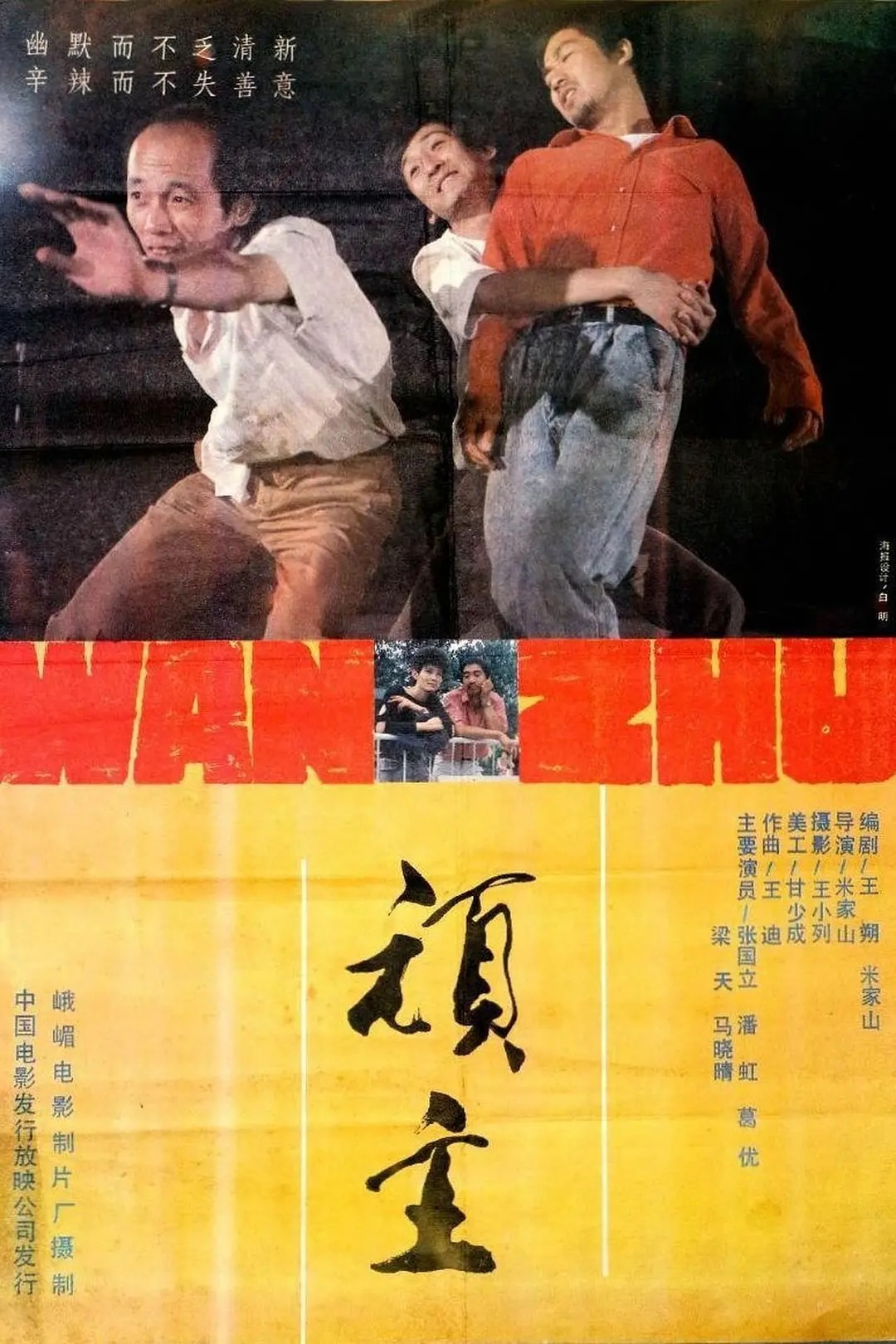 If the idea sounds familiar that’s because it’s been used in at least three other Mainland movies during the past 30-odd years – all, coincidentally, starring comic actor Ge You 葛优. The first, adapted from a 1987 novel by bad-boy author Wang Shuo 王朔, was Three T Company 顽主 (1988, aka The Trouble-Shooters), directed and co-written by Mi Jiashan 米家山 (see poster, left); the second, from a novella by Wang (but uncredited, in order to get it past the film bureau at the time), was Party A, Party B 甲方乙方 (1997, aka The Dream Factory), directed and co-written by Feng Xiaogang 冯小刚, then at the start of his career; and the third was Personal Tailor 私人订制 (2013), again directed by Feng and with an original script by Wang.
The first film adaptation of a Wang novel, Three T Company centred on three guys who set up a company to solve people’s problems; it’s, alas, little-known now, but the film has a 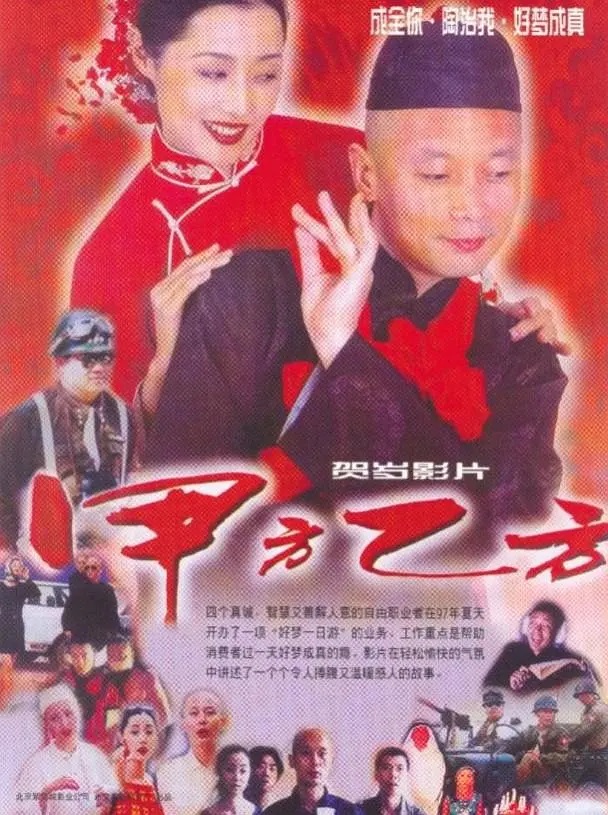 street-level feel, typical Beijing humour and somewhat chaotic tone that accurately reflects the incipient entrepreneurialism and social flux of late 1980s China. An early example of Mainland film-makers copying the Hong Kong tradition of the CNY film, Party A, Party B (see poster, left) was a huge success at the time; the episodic plot centred on a group of four acting out clients’ wish fulfilments, however weird, again with masses of Beijing humour and what was to become Feng’s trademark irony. Personal Tailor was basically a much glossier re-run of Party A, Party B, with a company of four dedicated to realising rich people’s fantasies in booming New China, where everything is possible at a price; like the other two films it was very much of its time and equally episodic, en route taking jabs at everything from official corruption to “culture” vs “popularism”.
Good Luck has none of those films’ subtexts – even in a shallow way – but one could say that it is also very much of its time, reflecting a China that’s no longer interested in self-analysis. It’s just what it looks like: three comic stories (plus a coda with a small twist) in which a street busker, a failed entrepreneur and a food deliveryman are helped to sort out their problems, and maybe realise their dreams. As such, it could be said to be a satire of (a) manufactured celebrity, (b) big-busines self-importance, and (c) city vs country values; but there’s nothing here that hasn’t been already satirised in so many other Mainland movies, and the humour is superficial, with no teeth.
The film plunges straight into the action, with an oily business type (epicene-looking Huang Cailun 黄才伦) taking over as the company’s CEO and immediately taking on the challenge of making a feisty, unattractive busker (comedienne Li Jiaqi 李嘉琦, formerly known as Lamuyangzi 辣目洋子) into a superstar. This episode, and the following one centred on comedian Wang Dalu 王大陆, just tick over, and disappointingly have lachrymose endings; more substantial, and the longest, is the third story, with accomplished farceur Qiao Shan 乔杉 as a failed deliverymen who longs to go back to his native village over CNY but doesn’t dare. The team fit him out as a mega-success, complete with Rolls-Royce and personal staff, but when he arrives he finds he’s not the only one making a “triumphant” return, and a face-saving struggle ensues.
The film is stuffed with Mainland comedians, all of whom have worked with each other over the years, either in troupes like Ma Hua FunAge 开心麻花 or in sketch TV. The final episode has the highest concentration, headed by Qiao and Wei Xiang 魏翔, and is the least sketch-like, instead surviving on star wattage. The episode has no soppy ending this time but also no real point to it beyond the obvious. On a technical level the film is well-appointed, beautifully shot around Qingdao by d.p. Chen Dan 陈丹 (Sky Hunter 空天猎, 2017) and smoothly assembled by its three editors.
CREDITS
Presented by Beijing Haoyun Lailailai Film & TV Media (CN), Tianjin Maoyan Weiying Cultural Media (CN), Beijing Huashan Swords Media (CN), Hixi (Beijing) Media Group (CN). Produced by Beijing Huashan Swords Media (CN).
Script: Zhu Lingfeng, Wang Shi, Sun Jingzheng, Kong Fanxing, Qin Xuan. Photography: Chen Dan. Editing: Fang Wei, Li Jing, Ding Rui. Music: Ma Shangyou. Art direction: Liu Jing. Costumes: Lin Peiyi. Styling: Wei Xiangrong. Sound: Yang Yuhui, Jiang Chunye. Visual effects: Li Zhichao. Executive direction: Wei Shu.
Cast: Bai Ke (Yao Xiaofeng/Yao Ke), Qiao Shan (Qiao Xiaoshan/Lan/Lazybones), Wang Dalu (Lun), Huang Cailun (Jia Ling), Li Jiaqi (Zhao Qingchen), Mi Mi (Doudou), Sun Jingzheng (Da Bo), Wei Xiang (Jia, village head), Xu Juncong (Da Cong), Wang Taili (Nian Yuzhou), Sun Yue (driver), Ai Lun (TV presenter), Wu Yue (helicopter pilot), Cui Zhijia (delivery man), Shao Sihan (Xiaochan, Qiao Xiaoshan’s village love), Ma Yuke (Jiajia), Yi Yunhe (Jianguo, successful villager), Wen Song (priest), Liang Tian (Liang, security guard), Hao Pengfei (Benshi), Chao Kun (Gensheng), Xiong Xin (Liu Jingyi, Lun’s girlfriend).
Release: China, 30 Nov 2024.