She’s Got No Name
酱园弄•悬案
China/Hong Kong, 2025, colour, 2.35:1, 95 mins.
Director: Chen Kexin 陈可辛 [Peter Chan].
Associate director: Han Shuai 韩帅.
Rating: 8/10.
Based on a grisly murder in Japanese-occupied Shanghai, this first film of two is an arresting call to attention, with big performances and an unfamiliar look.
 STORY
STORY
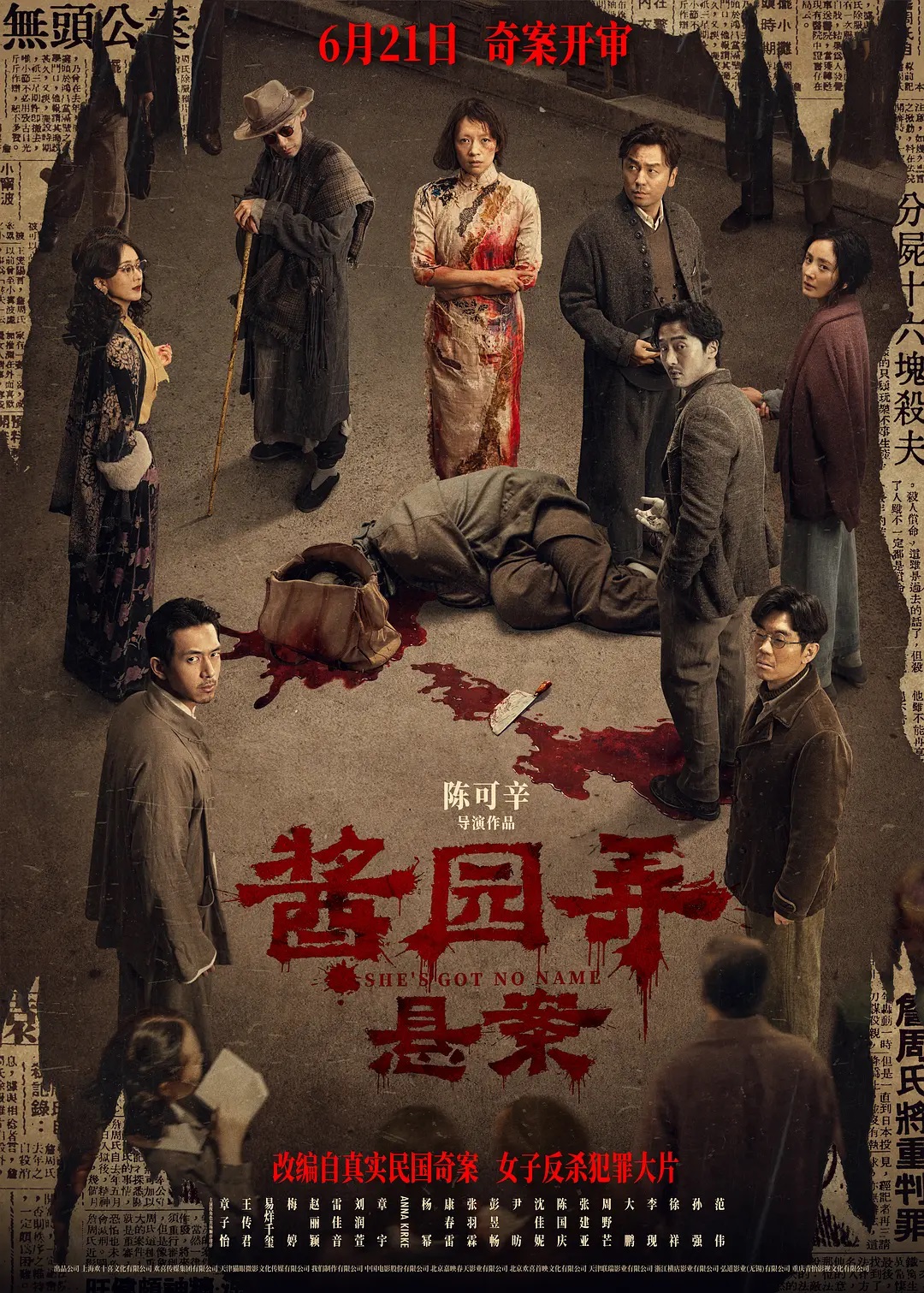
Japanese-occupied Shanghai, Mar 1945. In the middle of the night Zhan Zhoushi (Zhang Ziyi) leaves her flat in Jiangyuan (Beanpaste Garden) Alley, in Huangpu district, and throws a blood-stained bag into the river near Waibaidu Bridge on Suzhou Creek. Blood seeps through the floorboards of her flat onto the face of Song (Yi Yangqianxi), a blind fortune-teller who lives below; he wakes up briefly, and next day is seen with dried blood on his face. Meanwhile, the self-promoting writer and socialite Xi Lin (Zhao Liying), a divorcee who champions women’s rights, announces another of her plays at her regular theatre – a reworking of Henrik Ibsen’s A Doll’s House. The police, led by Huangpu district police chief Xue Zhiwu (Lei Jiayin), arrive at the flat and learn that Zhan Zhoushi spent a whole day dismembering the body of husband Zhan Yunying (Wang Chuanjun). Inside the flat she’s found cowering in a corner, covered in blood; she says she killed her husband and threw his head into Suzhou Creek. She’s arrested. Xue Zhiwu announces that the murder was a simple case of “marital discord” and the case is now closed, though the press question how a woman who is frail and only 1.6 metres tall could 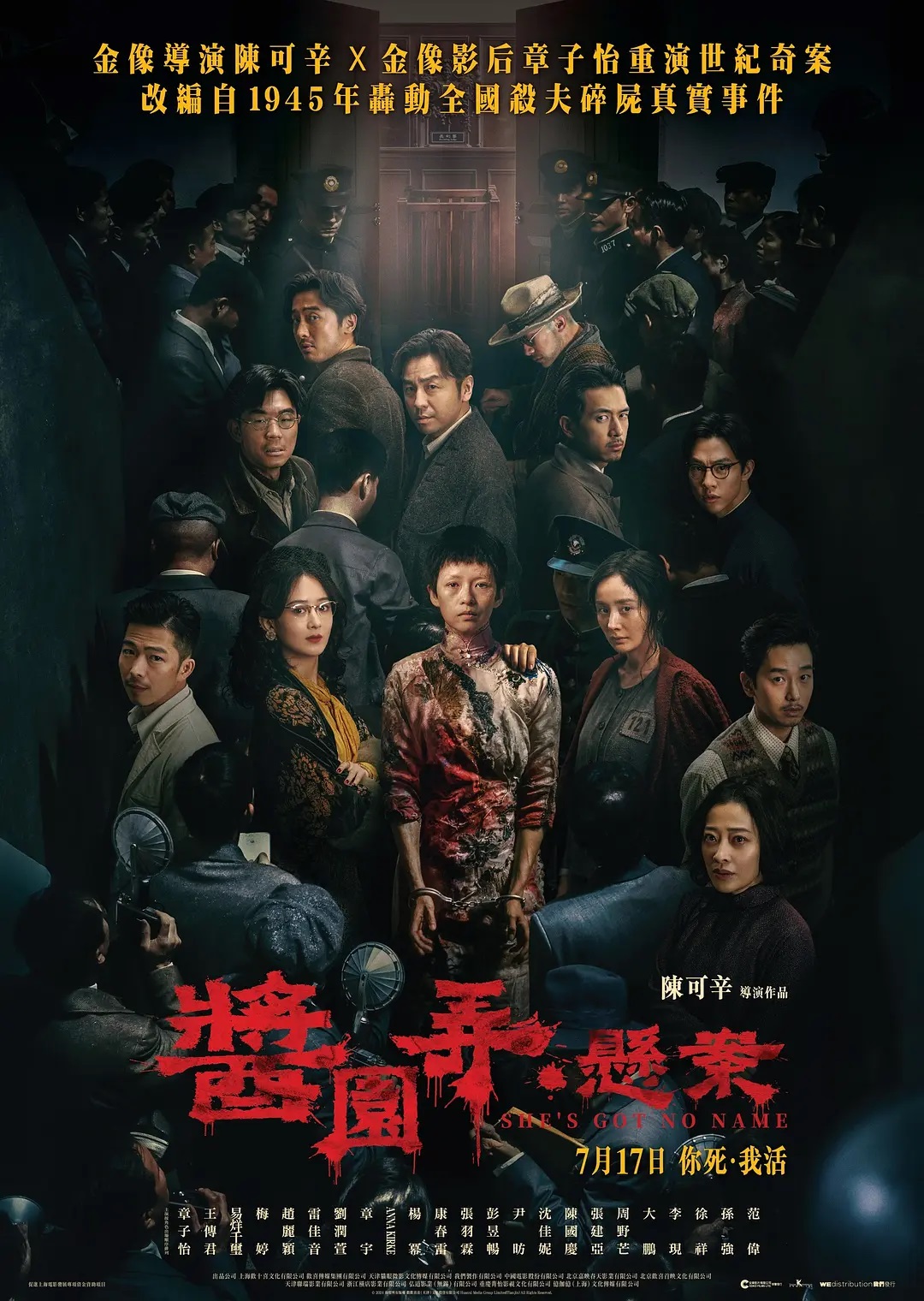 overpower a man, known as “the big guy” 大块头, who was strongly built and 1.8 metres tall. The police medical examiner (Zhang Yu) tells Xue Zhiwu that Zhan Yunying’s neck wound, which was small and deep, could not possibly have been made by the kitchen cleaver found in the flat. Xue Zhiwu brutally interrogates Zhan Zhoushi but she still maintains there were no other knives in her flat. He becomes uneasy when, after being beaten by him, she tries to hold his hand as if he is her late husband. The women’s cell in which Zhan Zhoushi is held is ruled by Wang Xumei (Yang Mi), a famous dancer who has been sentenced to death for harbouring a fugitive; she is bribing a Catholic nun (Anna Kirke), who regularly visits the prisoners, in a plan to get her sentence commuted. Wang Xumei befriends Zhan Zhoushi, knowing who she is. The police continue to dredge Suzhou Creek without finding the bag with the head. Xue Zhiwu questions blind fortune-teller Song, who says Zhan Zhoushi cut off her husband’s head so she wouldn’t be re-united with him in the afterlife. Song advises Xue Zhiwu to stay away from the case, as his and Zhan Zhoushi’s star signs are in conflict. Xue Zhiwu takes Zhan Zhoushi back to the scene of the crime and tries to trick her by pretending the police have recovered the head; she breaks down and admits there were two knives. However, at her trial on 5 Apr she pleads not guilty, as she heard on the way to the courthouse that the head is still missing. In court she accuses Xue Zhiwu to his face of forcing her to confess. The scene is observed by Xi Lin, and the trial is adjourned. Humiliated, Xue Zhiwu puts her in a cell with a wild boar and a kitchen cleaver to see if she can kill the animal; but he is forced to shoot the animal to save her life. (In 1935, before the Japanese Occupation, she had first met Zhan Yunying when he was working in a pawnshop and she was a maid with a well-off family. He had seemed charming and they had married the following year.) After her play is taken off by the theatre manager (Peng Yuchang) due to lack of business, Xi Lan decides to champion Zhan Zhoushi in an article describing how Zhan Yunying beat her and gambled and blamed her for his losses. In prison Wang Xumei reads Zhan Zhoushi the article. Feeling publically disgraced during the trial, Xue Zhiwu resumes the case, interviewing the landlord (Zhou Yemang) and his garrulous wife (Mei Ting). He discovers Zhan Zhoushi worked for a while in a cotton mill. (She had used the name Jin Lan, and had been recommended to the manager [Xu Yang] by a certain Zhang Baofu [Li Xian], who turned out to be one of her husband’s creditors. She had been secretly trying to pay off his gambling debts.) Xue Zhiwu brutally interrogates Zhang Baofu and fakes a confession that Zhang Baofu and Zhan Zhoushi together murdered Zhan Yunying. Meanwhile, in prison Wang Xumei tells Zhan Zhoushi that the Japanese will soon be gone and then they’ll be free. On 5 Aug Zhan Zhoushi and Zhang Baofu are put on trial, but the latter is accidentally killed by a car when trying to escape outside the courthouse. In court, Zhan Zhoushi says Zhang Baofu was the sole murderer. Xi Lin causes a commotion in court when she verbally defends Zhan Zhoushi, who then starts quoting passages from Xi Lan’s newpaper article about her. During a recess, Xue Zhiwu bribes the presiding judge (Sun Qiang) to sentence Zhan Zhoushi to death. Soon afterwards, Wang Xumei’s death sentence is suddenly brought forward and she is shot, despite being pregnant by one of the prison guards (Kang Chunlei) under a plan to get her sentence commuted. The Catholic nun then tells Zhan Zhoushi she can secretly reassign Wang Xumei’s pregnancy certificate to her and get her execution delayed. Meanwhile, the whole city descends into chaos as the Japanese and their collaborators flee, and Xue Zhiwu desperately tries to shoot Zhan Zhoushi in the crowded prison cell.
REVIEW
With only two features released during the past decade – child-abduction drama Dearest 亲爱的 (2014) and women’s volleyball celebration Leap 夺冠 (2020) – and his tennis biopic Li Na 李娜 (shot during 2018-19) still sitting on the shelf, it’s getting to be a long time between directing drinks for Hong Kong-born film-maker Chen Kexin 陈可辛 [Peter Chan], now 62 – though he’s kept busy behind the scenes as creative producer 监制 on a series of notable productions (SoulMate 七月与安生, 2016; Last Letter 你好,之华, 2018; Tale of the Night 长沙夜生活, 2023). After two sports movies in a row, he’s now extended his range with his first crime drama, She’s Got No Name 酱园弄•悬案, showing he can still surprise with his genre spins – in this case, on period Shanghai noir.
Just as Leap brought actress Gong Li 巩俐 back to the limelight after several years marking time, so She’s Got No Name does the same for Zhang Ziyi 章子怡, 46, who’s become a rarer and rarer sight on the big screen in recent years. Based on a true, unsolved murder case from WW2 Shanghai, it’s a fine platform for Zhang and strongly cast, as well as being an evocative re-creation of a city and an era that’s too often cliched in films and TV dramas. However, maybe because of its unremitting darkness, it failed to click in a major way with Mainland audiences, taking only a solid RMB375 million, less than half the hawl of Leap.
The film has had a circuitous history. Chen, who usually develops his own projects, was first sent the original script – by three writers – in 2015. He immediately thought of Zhang for the lead, but couldn’t get together the finance for the production he envisaged. After making Li Na and Leap, Chen finally began shooting Name in Dec 2023 and wrapped in early Mar 2024, with post-production rushed to meet a Cannes invitation for an out-of-competition slot (effectively the closing film) on 24 May. That version ran 150 minutes and received mixed reviews. After deciding it fell between two stools – too long for a single movie, not long enough to do the material justice – Chan cut a four-hour version from the existing footage that he deemed to be ideal and would work as a four-part TV drama. However, he was then persuaded to keep it as a big-screen movie – but, controversially, to be divided into two separate films running a total of three-and-a-half hours.
The first film, reviewed here, runs roughly an hour-and-a-half and retains the original Chinese and English titles of the Cannes version. After premiering as the Shanghai festival’s opening film this summer, it went on release a week later. The second film – some of whose new characters are trailed at the end of the first – follows the story into the post-WW2 era. No release date (or title) has beeen announced yet.
The final screenplay is credited to four people, three of whom had no scriptwriting experience at the time and who have gone on to very different careers. Shanghai-born Shi Ling 史零, then in his mid-30s, went on to write the iffy period drama, set in Inner Mongolia, In Search of Lost Time 海的尽头是草原 (2022), directed by Hong Kong’s Er Dongsheng 尔冬升[Derek Yee]). Northeast China-born Jiang Feng 蒋峰, then in his early 30s, was and still is a novelist. The oldest of the group, Shanghai-born Shang Yang 商羊, grand-daughter of playwright and essayist Du Xuan 杜宣, was then a journalist who was later Shi’s co-writer on Lost Time; she had already received a “special thanks” in the end credits to Chen’s period drama Bodyguards and Assassins 十月围城 (2009), so was perhaps the reason for the screenplay being sent to him. The fourth person, Wenzhou-born Pan Yiran 潘依然, appears to have been brought in later to fashion the final screenplay: she already had credits on Crazy Alien 疯狂的外星人 (2019) and two films directed by Zhang Yimou, Cliff Walkers 悬崖之上 (2021) and Snipers 狙击手 (2022, as a script planner), as well as some TV online drama series.
In a nutshell, the script centres on a 29-year-old wife, Zhan Zhoushi, who is found in a blood-drenched flat with the corpse of her abusive, gambling-addicted husband, Zhan Yunying, 31, whose head is missing and body has been hacked into 16 pieces. She first admits to killing him and disposing of his head in the river; but questions are raised in the press about how she could have committed the murder alone, given the size and strength of her husband and the absence from the crime scene of a suitable knife. Over time she also keeps changing her story, is tricked by a desperate police chief into false confessions, and while being held in prison is platformed by a self-serving writer-cum-socialite who champions women’s rights.
All this takes place in a Japanese-occupied Shanghai of 1945 that is gradually descending into chaos as the war is ending, people are fleeing the city, and the legal system is broken, with brutal police interrogations, a corrupt judiciary and overcrowded prisons. The script sticks fairly closely to the basic facts but invents several characters and is clearly – like this summer’s Dongji Rescue 东极岛, another WW2 drama based on a real event – a movie rather than a docu-drama. In this first film, there’s no mention of the backgrounds of the wife and husband (neither was actually born in Shanghai) and nothing earlier than 1935 (when they first met) is shown. The second part will continue the story of Zhan Zhoushi – who finally died in 2006 – in a city now governed by the Nationalists (KMT), who are eager to distance themselves from the period of Japanese occupation.
The film’s Chinese title translates as “Jiangyuan Alley: The Unsolved Case”, referring to the place in Shanghai’s Huangpu district where the murder took place. (“Jiangyuan” means “Beanpaste Garden”.) The film takes a largely chronological approach to the story, with only a few flashbacks – relatively brief and, unlike the Cannes version, not in b&w – to illustrate information the police chief gradually discovers about Zhan Zhoushi. The only real mystery that remains “unsolved” is not whether she killed and dismembered her husband – to which she originally admits – but whether she had an accomplice.
Layered on top of the whole story is the theme of women’s rights in pre-PRC China, where filing for divorce was practically unknown and spousal abuse had not yet become a political issue. Chen’s films have almost always centred on determined women, and here two lead the pack – Zhan Zhoushi’s cellmate, a onetime dancer convicted of harbouring a fugitive, and a divorced writer-cum-socialite who takes up Zhan Zhoushi’s case for her own career purposes. The former is played with quiet sass by Yang Mi 杨幂, 39, in one of her strongest and subtlest performances; but the latter, as played by a miscast Zhao Liying 赵丽颖, 37, in horn-rimmed glasses and a flouncy wig, strikes a phoney note and hardly looks in period. That’s a pity, as Zhao is a good actress in strong roles (Duckweed 乘风破浪, 2017; the deaf-mute in Article 20 第二十条, 2024; desert drama Tiger Wolf Rabbit 浴火之路, 2024; We Girls 向阳•花, 2025).
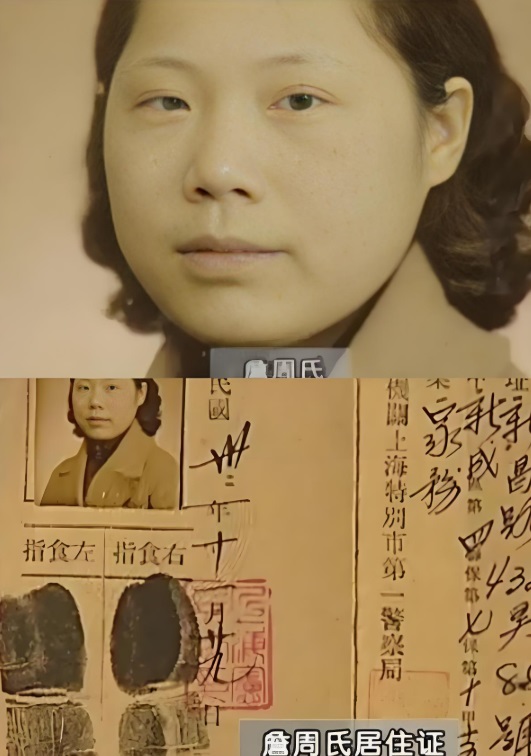 Between the two sits Zhang as Zhan Zhoushi, a largely reactive role, full of stubborn silences and fierce/frightened looks, but one that Zhang makes her own, despite looking nothing like the real character (see photo, left). It’s a role that could bloom in the second film, as she finds her feet in a city under a new government; here she’s subordinated to the two determined women who help her, as well as the sweep of unfolding events. But she still proves a match for her main persecutor, local chief of police Xue Zhiwu, who’s desperate to get the case closed and flee the city before the Nationalists arrive. With Zhan Zhoushi’s husband shown only in a few flashbacks, the film pivots mostly on the relationship between Zhan Zhoushi and Xue Zhiwu, a game of minds in which she keeps slipping out of his grasp however much he tries to bend the law. Lei Jiayin 雷佳音, 42, an under-rated character actor who’s recently had some notable leading roles in big movies (YOLO 热辣滚烫; Article 20, both 2024 CNY films), is terrific as the pompous police chief, infusing the part with dark comedy as well as desperate violence.
Though Name shows a much grubbier and more realistic Shanghai of the period – totally divorced from its usual romantic nostalgia in the art direction by Sun Li 孙立 and styling by Hong Kong’s Wu Lilu 吴里璐 [Dora Ng] – it’s still a very filmy movie, with big performances, large characters and dramatic climaxes that come thick and fast. It’s also full of cameos by name actors that may be expanded in the second film: Mei Ting 梅婷 as the landlord’s garrulous wife, comedian/director Da Peng 大鹏 as a locksmith (seen in only one brief shot), youth idol Yi Yangqianxi 易烊千玺 almost unrecognisable as a blind fortune-teller who lives downstairs, and Peng Yuchang 彭昱畅 as a theatre director, to name a few. All are supported not only by the design team but also by the dark, colour-drained photography of Taiwan-based d.p. Jake Pollock (reunited with Chen after their martial-arts genre spin, Wu Xia 武侠, 2011) and occasional gritty string interpolations by British composer Natalie Holt (Journey’s End, 2017; Herself, 2020). The film is an arresting call to attention but also not a complete work on its own; only after the second film appears will it be clear whether Chen’s bold gambit has paid off in a single 3½-hour drama.
CREDITS
Presented by Shanghai Huanxi Media Group (CN), Huanxi Media Group (CN), Tianjin Maoyan Weiying Cultural Media (CN), We Pictures (HK), China Film (CN), Beijing JQ Spring Pictures (CN), Beijing Huanxi Media Group (CN), Tianjin Lian Ray Pictures (CN), Zhejiang Hengdian Film (CN), Hongdao Pictures (Wuxi) (CN), Chongqing Qingyi Film & TV Culture (CN). Produced by We Pictures (HK), We Plus Production (Shanghai) (CN).
Script: Shang Yang, Jiang Feng, Shi Ling, Pan Yiran. Original script: Shi Ling, Jiang Feng, Shang Yang. Photography: Jake Pollock. Editing: Zhang Shuping [William Chang], Zhang Yibo. Music: Natalie Holt. Music supervision: Yu Fei. Art direction: Sun Li. Styling: Wu Lilu [Dora Ng]. Sound: Wu Jiang, Nopawat Likitwong. Action: Luo Yimin [Norman Law]. Visual effects: Jiang Chao. Creative advice: Cen Jianxun [John Sham].
Cast: Zhang Ziyi (Zhan Zhoushi), Wang Chuanjun (Zhan Yunying), Yi Yangqianxi (Song, blind fortune-teller), Mei Ting (Wang Chenshi, landlord’s wife), Zhao Liying (Xi Lin, writer), Lei Jiayin (Xue Zhiwu, Huangpu district police chief), Liu Runxuan (onstage Nora Helmer), Zhang Yu (Liang, medical examiner), Anna Kirke (Catholic nun), Yang Mi (Wang Xumei), Kang Chunlei (Kang Zhongliang, prison guard), Zhang Yulin (onstage Zhan Zhoushi), Peng Yuchang (Cai, theatre manager), Yin Fang (Zhang Yan, deputy editor), Shen Jia’ni (Wu Ling, editor), Chen Guoqing (prosecuting lawyer, first and second trials), Zhang Jianya (Zhang Jinzhao, Shanghai police chief), Zhou Yemang (Wang Yiyang, landlord), Da Peng [Dong Chengpeng] (He Huixian, locksmith), Li Xian (Zhang Baofu), Xu Yang (cotton-mill manager), Sun Qiang (presiding judge at second trial), Fan Wei (Ye Boxiu, lawyer), Zhang Zifeng (Ye Nianzhi, Ye Boxiu’s daughter).
Premiere: Shanghai Film Festival (Opening Film), 14 Jun 2025.
Release: China, 21 Jun 2025; Hong Kong, 17 Jul 2025.