Survival
生还
China, 2025, colour, 2.35:1, 106 mins.
Director: Gao Qunshu 高群书.
Associate director: Xiao Yifan 肖一凡.
Rating: 7/10.
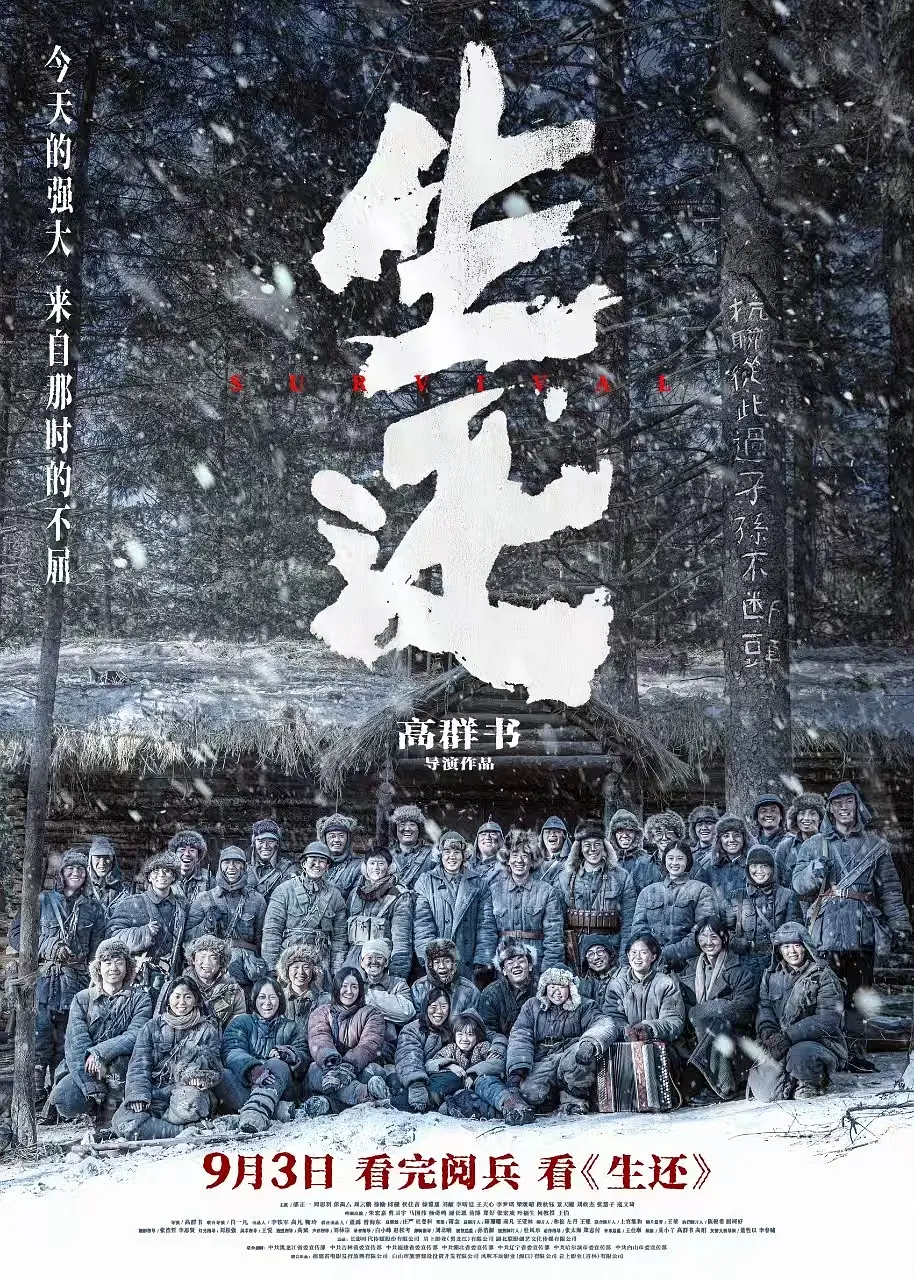
A tough, realistically shot group portrait of anti-Japanese guerrillas in snowy northeast China, seen through the eyes of a tough young teen girl.
 STORY
STORY
Heilongjiang province, northeast China, Chinese New Year’s Eve, 1938. About to turn 14, Li Tong (Shao Zhengyi) is a member of the 6th Army of the Northeast Anti-Japanese United Army, formed under the leadership of the CPC; it’s her second year in the snowy mountains, where the winters are savage and food is scarce. As everyone gathers at a secret location in the forest, young Xiaoma (Zhou Siyu) manages to kill a wild boar, so that evening everyone can celebrate with dumplings to eat, cooked by the women of the clothing depot led by Big Sister Pei (Qiu Jian). Geng (Peng Yusi), commander of the field hospital, announces that the Japanese have mobilised a whole division of 50,000 troops for a full-scale sweep of the region around Jiamusi city. Early the next morning, on New Year’s Day, the two log cabins in which everyone is sleeping are suddenly bombed and destroyed by Japanese troops. About a dozen people – men, women and children – manage to escape, sliding down a cliff and then trudging through the deep snow. All they have to eat are boiled pieces of the thick leather boots worn in the region. They make it to a village where Li Tong meets her father (Ma Guowei), whom she hasn’t seen for a year, and her elder brother (Zheng Hao). The villagers feed them and they later move off and join other forces to attack and blow up the Japanese-controlled Liudaojiang mine. During the operation Li Tong kills her first Japanese. Afterwards, everyone celebrates with a meal round a fire in the woods. Early next morning, however, they are suddenly attacked by Japanese troops. During the attack, the pregnant Jin Daozhen (Xu Yahui) goes into labour and, protected by the women and girls in the group, gives birth under fire to a girl, whom she names Jin Canlan. Geng and his men take out the Japanese’s grenade launcher and break a path out, but Li Tong goes missing. She later regains consciousness and runs for it as Japanese reinforcements arrive. From the hillside she sees some of the group, including Big Sister Pei, killed and others wounded and taken captive. She manages to surviv for three days in the mountain before finding the survivors of her group, now joined up with members of the better-equipped 1st Division, commanded by Chen Yuqing (Zhu Hongjia). Some 400,000 Japanese troops are hunting them all down, and the enemy has put a price on their heads to encourage traitors. En route, Jin Daozhen dies, having asked Li Tong to take care of her baby. And then Chen Yuqing decides the whole group must split up to avoid being captured. The members of the 1st Division leave for Harbin city but are immediately killed by an enemy plane. The next year is the toughest yet for resistance fighters, who now number only about 1,000 in the whole region, with villagers forbidden to give them food or shelter on pain of death. In Apr 1940 the surviving members of Geng’s group, including Li Tong, reaches the frozen Amur river bordering Heilongjiang province with the Soviet Union. There they try to make a run for it across the border to safety.
REVIEW
A tough but comradely portrayal of life among anti-Japanese guerrillas in northeast China from 1938-45, Survival 生还 is a war film where the brutal elements are as much the enemy as foreign invaders. Realistically staged in the same region (Heilongjiang) as it’s set, and told equally (if not more) from a female perspective, this latest hardboiled drama by Mainland writer-director Gao Qunshu 高群书 recalls elements from some of his earlier pictures – snowbound northeastern snowscapes (Old Fish 千钧。一发, 2008), striking use of location shooting (Wind Blast 西风烈, 2010), and an almost docudrama-like approach (Beijing Blues 神探亨特张, 2012). Seen through the eyes of a tough young teenage girl, the film is more a group portrait than an involving collection of individuals, though it does stir the heartstrings in its quietly moving epilogue.
After a strong start as a director with war-crimes drama The Tokyo Trial 东京审判 (2006), and crime dramas Old Fish, The Message 风声 (2009) and Beijing Blues, it’s since been an uneven decade-or-so for Gao, with his last two movies (WW2 spy thriller Seven Killings 刀尖, 2023; buddy-cop movie Three Old Boys 三叉戟, 2024) both delayed from reaching the screen by four to five years and then, despite their qualities, flopping at the box office (RMB51.7 million, RMB29 million). Survival, shot from Dec 2024 to Apr 2025 in Baishan and Chaoyang, suffered no delay in release but financially fared even worse, with a tiny RMB10.2 million this autumn. It probably wasn’t helped by there being much bigger, snowbound war movies in recent years (The Battle at Lake Changjin 长津湖, 2021; Snipers 狙击手, 2022) that were also stuffed with well-known faces. By contrast, Survival is small-scale with no big names and a relatively small budget.
The whole film is framed as a reminiscence by the adult Li Tong (only briefly seen) as she narrates events from her youth, starting as a young girl on the very eve of her 14th birthday after almost two years already in a section of the guerrilla force known as the Northeast Anti-Japanese United Army, set up by the CPC. The first hour or so follows the everyday life in the forested mountains of the motley group, including women of the clothing depot and men and women of the field hospital, all under Geng, their commander. The mood changes rapidly, from New Year’s Eve dumplings when one soldier kills a wild boar, through chummy carousing round a camp fire, to sudden death and destruction when Japanese troops attack without warning. Li Tong gradually emerges as a character in her own right when she gets separated from the group and only later re-finds her pals. In the meantime, she’s witnessed a woman giving birth under fire, killed her first Japanese, and managed to survive for three days on her own in sub-zero temperatures.
The remainder of the film fast-forwards through the five years to 1945, as the group, hunted by thousands of Japanese troops, finally makes it to the river border with the Soviet Union, where they attempt to cross into safety. Gao and his co-writers – including 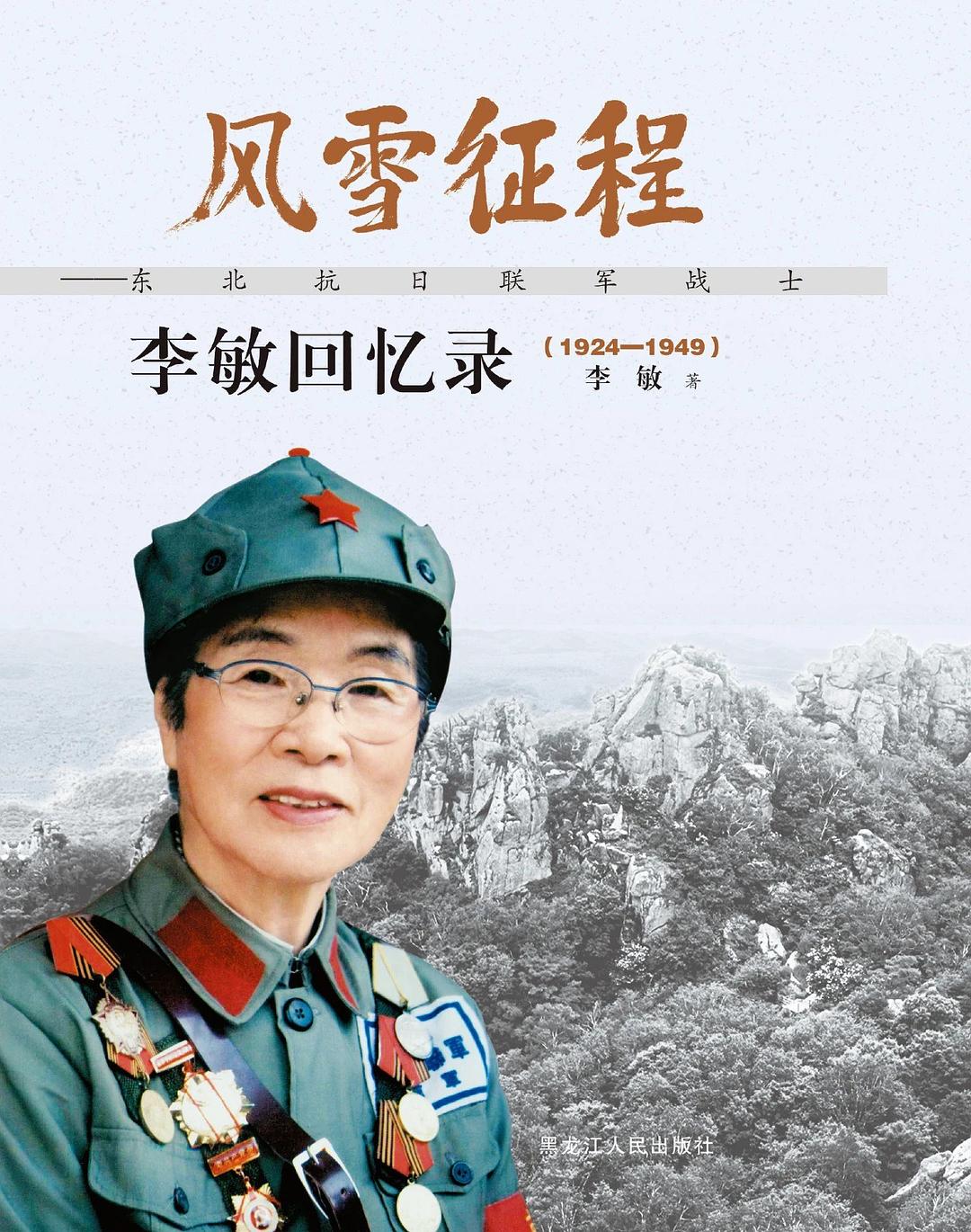 Mou Xiaoya 某小丫(literally, “A Certain Little Girl”), pen name for Zou Mengyue 邹梦月, who worked on the Valentine’s Day movie Eternal Moment 将爱情进行到底 (2011) as well as Gao’s well-written Seven Killings – based the screenplay on the 2012 memoir 风雪征程 (“Journey through Wind and Snow”) by Li Min 李敏, who like the fictional Li Tong joined the guerrilla group as a 12-year-old in 1936 (see cover, left). As played by 12-year-old child champion kickboxer Shao Zhengyi 邵正一, in her big-screen debut, the 14-year-old Li Tong isn’t much more than a gruff, heavily-garbed tomboy who says little – though that goes for many of the adult cast as well.
Though the main players are mostly introduced in the first 10 minutes with on-screen captions, it’s difficult to tell many of them apart, due to the thick winter clothing and relative lack of close-ups. It’s a recurring problem with many such films (as well as underwater ones) but Gao seems consciously to avoid focusing too deeply on any one character, preferring the group over the individual. Apart from the section of Li Tong’s brief isolation, all events are portrayed through group action – from the women all shielding a birth under fire to combat scenes in which any sense of geography seems to be deliberately avoided for a sense of mass chaos. Amid the various faces, Qiu Jian 邱健 stands out in early scenes as the head of the clothing depot, Xu Yahui 徐雅惠 as the plucky pregnant woman, and Li Xinting 李昕廷 as an accordion player – all newcomers who contribute to the film’s quiet drumbeat of female solidarity and friendship, which is movingly underscored in the film’s final reunion sequence. Among the men, Peng Yusi 彭禺厶 is fine as Geng, Zhou Yunpeng 周云鹏 as the head of supplies, and Zhu Hongjia 朱宏嘉 briefly as a division commander.
The widescreen camerawork by Zhang Haozhe 张浩哲 and Li Sixian 李思贤 has a frosty realism that manages to look good without being just photogenic. Notably, the visuals in action scenes – like the editing by Li Beixiang 刘北响 – aren’t the usual highly kinetic wobblecam. Like the gentle chordal music by Wang Shilin 王仕琳, the action scenes seem almost detached, with tension stoke in other ways, such as gliding drone shots or periods of silence (especially in the final battle). Credited as associate director is Xiao Yifan 肖一凡, a fellow Hebei’er who was art director on Beijing Blues and directed/co-wrote blackly humorous crime story Leaping over the Dragon Gate 龙门相 (2020), also set in the snowy northeast and with Zhang as d.p. and Gao as creative producer 监制.
CREDITS
Presented by Changying Times Media (CN), Rockview Pictures Entertainment (Heilongjiang) (CN), Hubei United Creative Pictures (CN). Produced by Beijing Qianlang Culture Communication (CN).
Script: Mou Xiaoya [Zou Mengyue], Gao Qunshu, Gao Yang. Memoir: Li Min. Photography: Zhang Haozhe, Li Sixian. Editing: Liu Beixiang. Music supervision: Wang Shilin. Art direction: Wang Yue. Costumes: Zheng Tianlong. Styling: Gao Bin. Sound: Liu Linzong, Bai Xiaofeng, Zhao Songkao. Action: Zhang Taihai, Zheng Zhifu. Military action: Lao Dao [Liu Hailei]. Special effects: Bai Chuang. Visual effects: Sun Haoyuan, Du Fengle (Beijing DustVFX). Executive directors: He Yonggao, Zhang Hongwei. Friendly directorial support: Dong Xingyi, Li Chunxiao.
Cast: Shao Zhengyi (Li Tong), Zhou Siyu (Xiaoma), Peng Yusi (Geng, field-hospital commander), Zhou Yunpeng (Ma Zifang, supplies head), Xu Li (Bai, field-hospital captain), Qiu Jian (Big Sister Pei, clothing-depot head), Hou Jiayin (Jin Yuxi), Xu Yahui (Jin Daozhen, pregnant woman), Liu Di (Zhang, quartermaster), Li Xinting (Li Yiqi, accordion player), Wang Tianxin (adult Li Tong), Li Mengyao (Liu Huannan, machine-gunner), Liang Songqing (Piao Minzhen), Duan Qiuyu (Zhang Jingshu, 3rd Army), Han Jiunuo (Fang Guizhi), Jing Tiantong (Hu Manfang, 3rd Army), Liu Zhengjie (Zheng Jie), Zhang Huizi (Liu Zhiqing), Kou Wenqi (assistant machine-gunner), Liang Hao (Wang, medical officer), Guo Qingxi (Xiaolin, nurse), Liu Yitong (Liu, medical officer), Zhao Xuanying (adult Liu Zhiqing), Chen Xuewei (Sister Xia, Liu Zhiqing’s mother), Zhang Weifu (Old Zhao, village comms officer), Zhu Hongjia (Chen Yuqing, 1st Division commander), Cao Weiyu (Yang Ke), Ma Guowei (Li Tong’s father), Yang Qiming (Zhang Tailong, 1st Division deputy chief of staff), Lu Chang’en (He Laoliu, executed villager), Miao Bo (Zhou Baozhong), Zheng Hao (Li Ming), Zhang Hongwei (Zhang Songzhi, party secretary), Wang Qiao (Li Tong’s aunt).
Release: China, 3 Sep 2025.