Dead to Rights
南京照相馆
China, 2025, colour, 2.35:1, 136 mins.
Director: Shen Ao 申奥.
Rating: 9/10.
Powerful Nanjing Massacre drama is among the best yet, with involving characters and subtle direction that make the events even more horrific.
 STORY
STORY
China, 1937. After the Battle of Shanghai, the Japanese army attacks Nanjing, attempting to occupy it and force the Chinese government to surrender. Amid the chaos as people try to leave the city, a postmaster tries to help one of his staff, postman no. 1213 Su Liuchang (Liu Haoran), to leave with him on a postal steamboat at Xiaguan wharf; but the postmaster is killed by a Japanese plane strafing the streets. On 13 Dec Nanjing garrison commander Tang Shengzhi flees and Japanese troops occupy the city. They announce they will abide by the Geneva Convention if Chinese troops lay down their arms. But as the Japanese army arrives at Zhonghua Gate, it starts committing mass slaughter. At Yijiang Gate the Chinese army shoots its own men who, under orders of Tang Shengzhi, are trying to retreat. While searching for his younger brother Cunli, police sergeant Song Cunyi (Zhou You) gets caught up in the chaos, narrowly escaping with his life. At Zhonghua Gate, Japanese major Kuroshima starts executing Chinese POWs, in contravention of the Geneva Cnvention, and tells army photographer Ito Hideo (Harashima Daichi) to photograph the act. In the backstreets Su Liuchang ends up pursued by Kuroshima’s men; Kuroshima orders Ito Hideo to “be a soldier” and shoot him. But when Ito Hideo sees a photo album among Su Liuchang’s belongings, he asks if he works at Jixiang Photo Studio 吉祥照相馆, aka Kee Hiong Photography, whose name is on the album, as he urgently needs his film developed and sent to Japanese headquarters. Su Liuchang pretends he does and has his life spared. All of this is observed by Wang Guanghai (Wang Chuanjun), a collaborator who is working as an interpreter for a Japanese officer to get travel passes for himself, his wife and his young son. Su Liuchang takes everyone to the photo studio, which is deserted; he pretends to be an apprentice there, and tells them his name is Chen Yongtai. He sees the owner, Jin Chengzong (Wang Xiao), hiding in a cupboard but manages to conceal him from the Japanese. After inspecting the place, Ito Hideo says he’ll be back for the photos the following evening, and gives Su Liuchang a note protecting him from being killed in the meantime. Su Liuchang lets Jin Chengzong out of hiding – as well as his wife (Wang Zhen’er) and young daughter (Yang Enyou) and son (Lou Zhiyuan) from the cellar – and Su Liuchang is offered a stake in the photo studio if he will help them escape. Su Liuchang, who has no interest in photography, just tells Jin Chengzong to develop the rolls of film and give himself up, along with the prints, to Ito Hideo the next day. He then runs off. In the streets he sees Japanese soldiers shooting Chinese on a whim, as well as Chinese being torched with a flame-thrower for fun. Shocked, he runs back to the photo studio, accepts Jin Chengzong’s offer and is given a crash course in film developing. Next day, Ito Hideo is pleased with the results and tells Su Liuchang to develop a roll in front of him, which Su Liuchang nervously does. Afterwards, Ito Hideo calls him “a friend” and gives him a food parcel; later, he says he’ll arrange a travel pass for Su Liuchang to leave Nanjing. Wang Guanghai persuades him to make it two passes, pretending Su Liuchang has a wife, singer Lin Yuxiu (Gao Ye). In fact, Lin Yuxiu is Wang Guanghai’s mistress. She comes to stay, bags packed, at the studio, which is now an officially protected building; but she immediately guesses there are other people hiding in there. Su Liuchang is suspicious of her – until she opens one of her trunks, revealing a wounded Song Cunyi hiding inside. On 17 Dec 1937 the Japanese army officially enters Nanjing by Zhonghua Gate, and Su Liuchang and Co. face further dangers.
REVIEW
A Nanjing photo studio – the meaning of the film’s Chinese title – becomes a small centre of hope, resistance and proof for history in Dead to Rights 南京照相馆, a powerful drama set during the winter of 1937/38 when the Nipponese army slaughtered hundreds of thousands of Chinese soldiers and civilians in a massacre that Japan has still to officially apologise for. This fourth feature by Northeast China-born, ethnically Korean writer-director Shen Ao 申奥, 39, is his strongest entry yet in a career that already includes the notable black rom-com My Dear Liar 受益人 (2019) and hit scamming drama No More Bets 孤注一掷 (2023). (His third feature, Escape from the Outland 用武之地, a Chinese hostage drama set somewhere in Africa, starring Xiao Yang 肖央, Qi Xi 齐溪 and Ren Dahua 任达华 [Simon Yam], still awaits a release date.) Box office for Rights has not been quite on the humoungous level of Bets but still an extremely hunky RMB2.99 billion, and is forecast to make RMB3.01 billion by the end of its run, making it the year’s no. 3 earner so far (behind Detective Chinatown 1900 唐探1900 and Ne Zha 2 哪吒之魔童闹海).
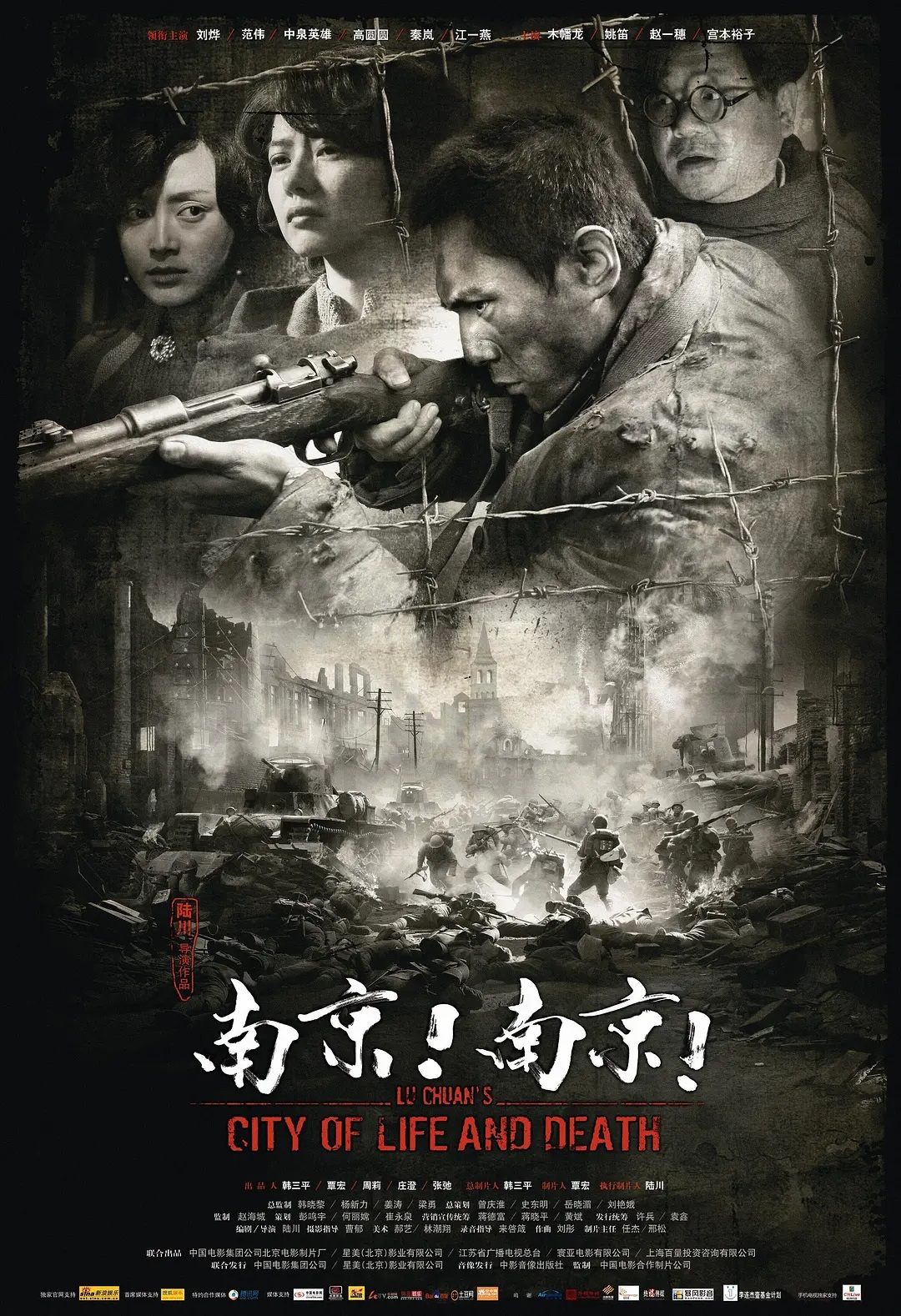 As far as the half-dozen or so Nanjing Massacre dramas go, Shen’s movie is the best yet, alongside the very different but equally wrenching City of Life and Death 南京!南京! (2009, dir. Lu Chuan 陆川, see poster, left). Where Lu’s film, shot in b&w, was at times semi-impressionistic, at others gut-wrenchingly up close and personal, Shen’s is more a classically constructed, superbly played drama, but all the more shocking for its casual depiction of slaughter and with a pallette that’s drained of almost all colour. Other films set against the massacre don’t come close to these two, including the disappointing The Flowers of War 金陵十三钗 (2011, dir. Zhang Yimou 张艺谋) and two westerner-centred dramas, the sluggish John Rabe (2009, Florian Gallenberger) and the opening section of The Children of Huang Shi (2008, Roger Spottiswoode).
Of the two remaining Chinese-directed versions, both released in 1995, the Hong Kong production Black Sun: The Nanking Massacre 黑太阳 南京大屠杀 (dir. Mainland-born Mou Dunfei 牟敦芾) has its moments but is almost a docu-drama, veering between serious discussion and trashy exploitation, while the China/Taiwan co-production Nanking 1937 南京大屠杀 (aka Don’t Cry, Nanking 南京1937, dir. Wu Ziniu 吴子牛) is far better, with impressively detailed, realistic production values, but weakened by a somewhat simplistic script.
Where Nanking 1937, with its central story of a Sino-Nipponese family, made a small effort in its early stages to depict both sides of the conflict, so Dead to Rights also pays lip service to presenting some Japanese in more detail than just crazed murderers. Chief among these is one of the most powerful characters in the movie – a young Japanese army photographer whose need to get his films processed leads him to a photo studio, where for practical reasons he befriends a young Chinese who pretends to be an apprentice there. In fact the latter is a postman who’s been trapped in the city by the Japanese army’s occupation; but the army photographer’s offer to him of travel passes becomes a way of helping the family of the studio’s real owner escape the doomed city. As played by Harashima Daichi 原岛大地, 27, a onetime child actor who’s ironically made a career playing Chinese in Chinese films (Blood Stained Shoes 绣花鞋, 2012; Sword Master 三少爷的剑, 2016), the baby-faced photographer who seems to have reservations about his horrific job and a genuine interest in local culture turns out, in a neat script twist from the 100-minute mark on, to be the scariest of all the Japanese, providing the film’s true climax.
The screenplay – by Shen, regular co-writer Xu Luyang 许渌洋, and Zhang Ke 张珂 (political biopic The Pioneer 革命者, 2021; Korean War drama The Volunteers: To the War 志愿军 雄兵出击, 2023) – was inspired by the true story of photo-studio apprentice Luo Jin 罗瑾 and his classmate Wu Xuan 吴旋 who tried to preserve photographic evidence of the Japanese army’s war crimes. From that basic idea, Shen & Co. have fashioned an involving, multi-layered occupation drama that includes the studio’s owner and his family, a simple postman who seizes an opportunity but later becomes converted to his benefactors’ plight, a collaborator-interpreter who swings between self-interest and patriotism, and the young Japanese photographer who brings them all together.
The characters are all familiar from other war films but Shen explores the usual issues of patriotism, collaboration, fidelity and so on in subtle ways, not least in the characters of the interpreter Wang Guanghai (unobviously played by Wang Chuanjun 王传君), singer Lin Yuxiu (Gao Ye 高叶, Article 20 第二十条, 2024, always strong in supporting roles) and studio owner Jin Chengzong (Wang Xiao 王骁, the deputy chief prosecutor in Article 20). In the centre of these strong characters, the simple postman Su Liuchang is quite a neutral role, and played as well as is possible by Detective Chinatown regular co-lead Liu Haoran 刘昊然.
Unshowily shot in widescreen by d.p. Wang Tianxing 王天行 (Kaili Blues 路边野餐, 2015; No More Bets) – but with the colour almost totally bled out at the start, apart from reddish tones, which are then allowed to gradually seep in – the movie has a natural realism that owes much to the giant city set constructed with painstaking fidelity to the real thing by art directors Lin Mu 林木 (Love Life Light 照明商店, 2023) and Li Anran 李安然. (The set is now a tourist attraction in Shanghai Film Park.) But equally powerful is the way in which Shen doesn’t dwell on the casual, day-to-day slaughter of civilians. Where other movies have made this the main attraction, Shen’s primary interest in creating characters with whom the viewer can become emotionally engaged makes the moments of unthinking brutality – from a riverside mass execution to games with a flame-thrower – seem even more horrific.
CREDITS
Presented by Zhongying (Wuxi) Film Studio (CN), Beijing Super Lion Culture Group (CN), Yuuya (Shanghai) Media (CN), China Film Group (CN), Omnijoi Film & TV Culture Group (CN), Shanghai Dirty Monkeys Studio (CN), Zhejiang Hengdian Film (CN), Wanda Media (CN), Shanghai Film Group (CN).
Script: Xu Luyang, Zhang Ke, Shen Ao. Photography: Wang Tianxing. Editing: Jiang Yijun, Shen Ao. Music: Peng Fei. Production design: Lin Mu. Art direction: Li Anran. Styling: Tang Ning. Sound: Lin Siyu. Action: Yao Xingxing. Visual effects: Li Tao. Artistic supervision: Piao Mu. Second-unit direction: Ge Rongyun.
Cast: Liu Haoran (Su Liuchang), Wang Chuanjun (Wang Guanghai), Gao Ye (Lin Yuxiu), Wang Xiao (Jin Chengzong), Zhou You (Song Cunyi), Yang Enyou (Jin Wanyi), Harashima Daichi (Ito Hideo, Japanese army photographer), Wang Zhen’er (Zhao Yifang, Jin Chengzong’s wife), Yang Haoyu (law officer), Liu Yichun (Fenghua), Yan Dongnan (Inoue, Japanese colonel), Azuma Shinji (Kuroshima, Japanese major), Takahashi Nobuaki (Ikeda Nagatomo, specialist photo developer), Kimura Masato (Tani Hisao, Japanese army vice-commander), Yao Weiping (Matsui Iwane, general, Japanese army commander), Lou Zhiyuan (Jin Chengzong’s son).
Release: China, 25 Jul 2025.