I Know Who You Are
抓特务
China, 2026, colour, 2.35:1, 141 mins.
Director: Feng Xiaogang 冯小刚.
Rating: 6/10.
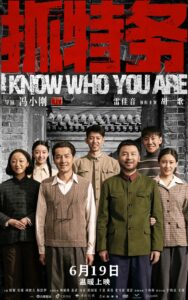
A light drama about two neighbours’ frenmity, obsessiveness and duplicity across 35 years, this is ultimately a single idea that’s stretched way too far, despite fine performances all round.
 STORY
STORY
Beijing, 1 Oct 1949. While people are celebrating the official founding of the People’s Republic of China, in a sidestreet primary-school teacher Feng Jingbo (Hu Ge), who is actually a sleeper KMT agent (codename “5182”) appointed by top spy Yan Diankun (Yu Hewei), is having his hair cut by local barber Bao (Jiang Wu). Xiao Dali (Lei Jiayin), a PLA cadre who has just been assigned to head the local police station, happens to pass by while he’s being shown around the neighbourhood by a local policeman, Wang Liujin (Liu Peiqi). Always on the lookout for spies, Xiao Dali immediately becomes suspicious of Feng Jingbo from something the latter casually says. When Xiao Dali is suddenly called away to pursue a gunman spotted in the street, Feng Jingbo, suspecting the gunman is also a foreign agent, helps him escape by raising the alarm and then misdirecting the police. Later, Xiao Dali investigates Feng Jingbo’s background as a teacher, visits him at his flat – in the same courtyard building where Yan Diankun used to live before fleeing Beijing – and later tells him he’s moving with his family into the flat downstairs which has been empty since the previous occupant committed suicide there. Feng Jingbo realises Xiao Dali is obsessed with proving he’s an enemy agent. When the local brothel, Cloud Fragrance Pavilion, is closed down by government decree, Feng Jingbo asks Xiao Dali if he’ll act as matchmaker between him and one of the brothel’s cleaners, Liu Yemei (Zhang Yao), who respects him as a teacher and occasionally cleans for him. Though he has no special feelings for the uneducated young woman, Feng Jingbo thinks that marrying her will give him greater cover. Xiao Dali is always trying to eavesdrop on Feng Jingbo, and he thinks some music he often hears being played is some kind of call sign; he tries to identify it with the help of a music teacher but Feng Jingbo then tells him it’s a well-known Russian piece, Pictures at an Exhibition. 1951. Xiao Dali keeps overhearing Feng Jingbo listening at night to a radio broadcast about the current prices of vegetables in Hong Kong. He doesn’t realise it’s actually a secret numerical code. One day he almost catches Feng Jingbo sending a message by morse code, but the latter hears him just in time. Xiao Dali’s political superior, Qi (Yu Zhen), announces that that Yan Diankun has escaped to Hong Kong and is now the KMT’s head of counter-intelligence; he left behind four radio sets for agents to use in Beijing, and so far the police have found three. Xiao Dali suspects Feng Jingbo must have the fourth but can’t make any charges stick, thanks to Feng Jingbo’s foresight. 1954. Liu Yemei gives birth to a daughter; but the marriage has already broken down and Feng Jingbo has been spending time with Xu Xiaoyu (Zhang Xueying), daughter of the primary school’s headmaster, Xu (Chen Guoxing). When Feng Jingbo goes out one evening and doesn’t come back, Liu Yemei raises the alarm with Xiao Dali and his wife Liu Yaqin (Chuai Ni), who find Feng Jingbo and Xu Xiaoyu making love in her flat. Xu won’t hear of Feng Jingbo divorcing his wife to marry his daughter. Liu Yemei ends up going back to her home village and taking her child with her. That winter, lonely and depressed, Feng Jingbo tries to commit suicide but by chance is saved by Xiao Dali. 1958. Xiao Dali is wondering whether he’s been wrong about Feng Jingbo the whole time. Meanwhile, Feng Jingbo is honoured as one of 10 “model workers”. Liu Yemei also returns with her four-year-old daughter, Feng Kangmei, and eventually Feng Jingbo agrees to form a family again – for the sake of the child, who’s ill-nourished from living in the countryside. 1968. Xiao Dali has been sent to a re-education camp on suspicion of being a foreign agent (codename “5182”); his elder son, Xiao Xinwei (Lin Xiaofan), 19, joins a production team in Shanxi province; and his wife, Liu Yaqin, tries to raise their young son alone. She is then detained as well. Meanwhile, Liu Yemei accidentally finds Feng Jingbo’s 20-year-old KMT commissioning document hidden behind a framed picture. Feng Jingbo is plagued by guilt but Liu Yemei tells him to keep his mouth shut for the sake of their daughter, who’s just gone off to join the PLA. 1981. With the Cultural Revolution over, and Deng Xiaoping now China’s leader, Xiao Dali has been released – though not in time to see his wife, who has committed suicide. Xiao Xinwei has joined the police force and his father wants him to carry on trying to trap Feng Jingbo, even though Xiao Xinwei and Feng Kangmei are in a romance. 1984. Feng Jingbo is now headmaster of his primary school and Xiao Dali retires from the police force. But after 35 years the latter still hasn’t given up hope that one day his frenemy will privately confess to him.
REVIEW
An often entertaining study of frenmity, obsession and duplicity between two men across 35 years, I Know Who You Are 抓特务 is ultimately a single idea that’s stretched way too far for an almost 2½-hour film, despite characterful playing by the whole cast. Like the previous two features of veteran director Feng Xiaogang 冯小刚 (If You Are the One III 非诚勿扰III, 2023; We Girls 向阳•花, 2025), it’s a nice idea, often beautifully played in Feng’s trademark sarcastic style, but with an uneven script that, in this case, loses its mojo in the 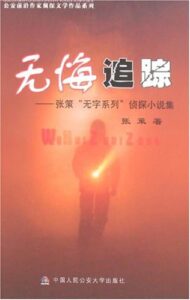 final half-hour as a new generation hijacks the story during its journey from 1949 to 1984. Though the film is a lightly comic character study rather than a serious political drama, Mainland audiences were unimpressed and the film managed to take only a meh RMB120 million (on a reported budget of around RMB200 million) – slightly more than the flop IYATOIII and only around a half of We Girls’ polite box-office hawl.
The plot – about a Beijing police officer who becomes obsessed with the idea that his neighbour, a primary-school teacher, is actually a KMT spy – is based on a short story, Remorseless Pursuit 无悔追踪 (see left), by Zhang Ce 张策, who himself worked in the city’s police force as a publicity officer and deputy editor of its house magazine. Feng has stated that, when he and writer Wang Shuo 王朔 once owned a film company together, they acquired the rights around the early 1990s but had to wait till the time was right to film it. Meanwhile, the short story was turned into a 20-part TV drama, with the 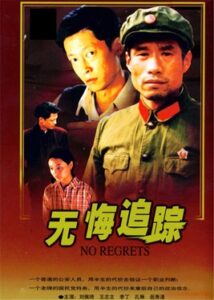 same Chinese title but known in English as No Regrets (see poster, left), with Liu Peiqi 刘佩琦 as the police officer, Wang Zhiwen 王志文 as the teacher, and a cast including actress Li Bingbing 李冰冰, then at the start of her career, as the teacher’s daughter. Directed by Yin Li 尹力, it was first broadcast in 1996 but only got nationwide censorship clearance after 2000. It has since come to be regarded as one of the finest TVDs of that era.
The scriptwriter was Shi Jianquan 史建全, who is also credited with the script of I Know. Apart from the change of title to 抓特务 (literally, “To Catch a Spy”), the film has several differences compared with the TVD. The latter, for example, starts with b&w documentary footage of celebrations on 1 Oct 1949 (official founding date of the PRC) before morphing into colour as the police officer, Xiao Dali, walks the neighbourhood and happens to overhear something said by the teacher, Feng Jingbo, in a back-alley barber’s shop. By contrast, the film opens with a noirish sequence where Feng Jingbo is officially appointed as a KMT spy and told to stay in Beijing and not to follow other Nationalists to Taiwan. Thus, when the film switches to Beijing’s backstreets during the 1 Oct celebrations, the audience is already primed that the young man in the barber’s shop is a sleeper spy when Xiao Dali become suspicious of him. It’s a small but telling difference. A bigger one is to the ending: in the TVD this takes place in autumn 1988 and centres on a long letter written by Feng Jingbo to Xiao Dali; in the film, which ends in 1984, the two characters meet face-to-face for a boozy session – which brings a nice sense of personal closure to the two men’s weird relationship. In the TVD the ending is much more impersonal.
The film’s central problem is that a story that can be involvingly spread across 13-or-so hours of TV, with leisurely diversions into supporting characters and other byways, is not necessarily suitable for a two-hour-plus movie, which operates by tighter dramatic rules. The script makes out a reasonable case for Xiao Dali’s suspicions, which could initially be put down to the political paranoia of the time (1949), as well as his over-eagerness to prove himself as a spy-catcher, but which are later grounded in harder, if still unprovable, evidence. But it’s still not enough to justify an obsession that lasts over 30 years, and centres on a man who is otherwise a pillar of the local community. When the film shifts to the 1980s, and the two men’s children take over some of the story, Xiao Dali and Feng Jingbo are shifted aside – two outdated characters in a less paranoid political environment as China moves on.
That’s partly the point of the whole film – but a point that would have worked much better across, say, 110 minutes rather than 140. Where a TVD can take its time, a feature film has to maintain a sustained tone and dramatic architecture, and I Know, despite many fine moments, doesn’t manage to do so. As the story keeps shifting dates every 15-20 minutes, there’s also the nagging distraction that the movie is just another light drama that trots through key moments in the PRC’s history. Again, in a more leisurely TVD this structure would not be a problem; in a two-hour-plus film a time period hardly has time to register before moving on to another. (It’s also worth noting that, whereas the TVD had a very natural, convincing sense of period, the film has a more backlot look, despite plenty of hutong detail.)
Feng’s movie is, however, still worth a look just for its cast. A regular in the movies of Zhang Yimou 张艺谋, but recently getting more leading roles (YOLO 热辣滚烫, 2024; Article 20 第二十条, 2024), Lei Jiayin 雷佳音, 43, brings all his skills as a character actor to the role of Xiao Dali, his early political passion gradually mellowing into a resigned acceptance of defeat after endlessly making a fool of himself with his superior. As the teacher-spy, Hu Ge 胡歌, also 43, who’s mainly a TV actor but occasionally makes a mark in film (Gold or Shit 走走停停, 2024), is a suitably low-key, almost blank foil, a reluctant spy but still brilliant in covering his tracks. Among the strong supporting cast, Chuai Ni 啜妮 (the prison officer in We Girls) is especially good as Xiao Dali’s tolerant wife and actress-singer Zhang Yao 张瑶 (the wife’s younger workmate in The Poet 诗人, 2018) ditto as Feng Jingbo’s token, illiterate wife. In general, the female roles are especially good at showing how relationships change and adapt over the years – unlike the two lead men’s.
In a small in-joke, Liu Peiqi, who played Xiao Dali in the TVD, plays an idiot policeman here. The film was shot from early Oct 2024 to first-half Jan 2025, largely at a movie town in Hainan island, southern China. Technically, the whole film is fine, with Zhao Xiaoding 赵小丁, who shot Feng’s Only Cloud Knows 只有芸知道 (2019) but is better known as the regular d.p. of Zhang Yimou 张艺谋, supplying the good-looking images.
CREDITS
Presented by Damai Entertainment (Beijing) (CN), China Film Group (CN), Zhejiang Dongyang Mayla Media (CN), Changchun Film Studio Group (CN), Chinese Entertainment (CN), Kunshan Zhouzhuang Shuangqiao Film Production (CN), New Classics Media (CN).
Script: Shi Jianquan. Short story: Zhang Ce. Photography: Zhao Xiaoding. Editing: Fan Zhaoshuo. Music: Han Hong. Production design: Huang Baorong. Art direction: Lin Chaoxiang, Zhang Nan. Costume design: Gu Jinhua. Sound: Wu Jiang. Visual effects: Jiang Chao, Huang Canzhou. Executive direction: Zhao Zuxiang.
Cast: Lei Jiayin (Xiao Dali), Hu Ge (Feng Jingbo), Chuai Ni (Liu Yaqin, Xiao Dali’s wife), Zhang Yao (Liu Yemei, Feng Jingbo’s wife), Lin Xiaofan (Xiao Xinwei, Xiao Dali’s elder son), Yang Shuyi (Feng Kangmei, Feng Jingbo’s daughter), Liu Peiqi (Wang Liujin, policeman), Jiang Wu (Bao, barber), Yang Qing (Bao’s wife), Chen Guoxing (Xu, school headmaster), Yu Zhen (Qi, political bureau director), Huang Man (Su), Yu Hewei (Yan Diankun), Zhang Xueying (Xu Xiaoyu, headmaster’s daughter), Liang Jie (Cui Yuanyuan, accordion player), Gan Yunchen (Sun Huanzhang), Wang Rui (Xiao Xinmin), Cai Jiamin (Xiaoheizi, policeman), Ding Wenbo (Xiao’anzi, policeman), Wang Xiaoyu (Li San, rickshaw man), Shi Rui (Li San’s wife).
Release: China, 19 Jun 2026.