Gold or Shit
走走停停
China, 2024, colour, 2.35:1, 103 mins.
Director: Long Fei 龙飞.
Rating: 8/10.
Beautifully written and played light comedy of manners centred on a loser who returns to his hometown but still has big ideas.
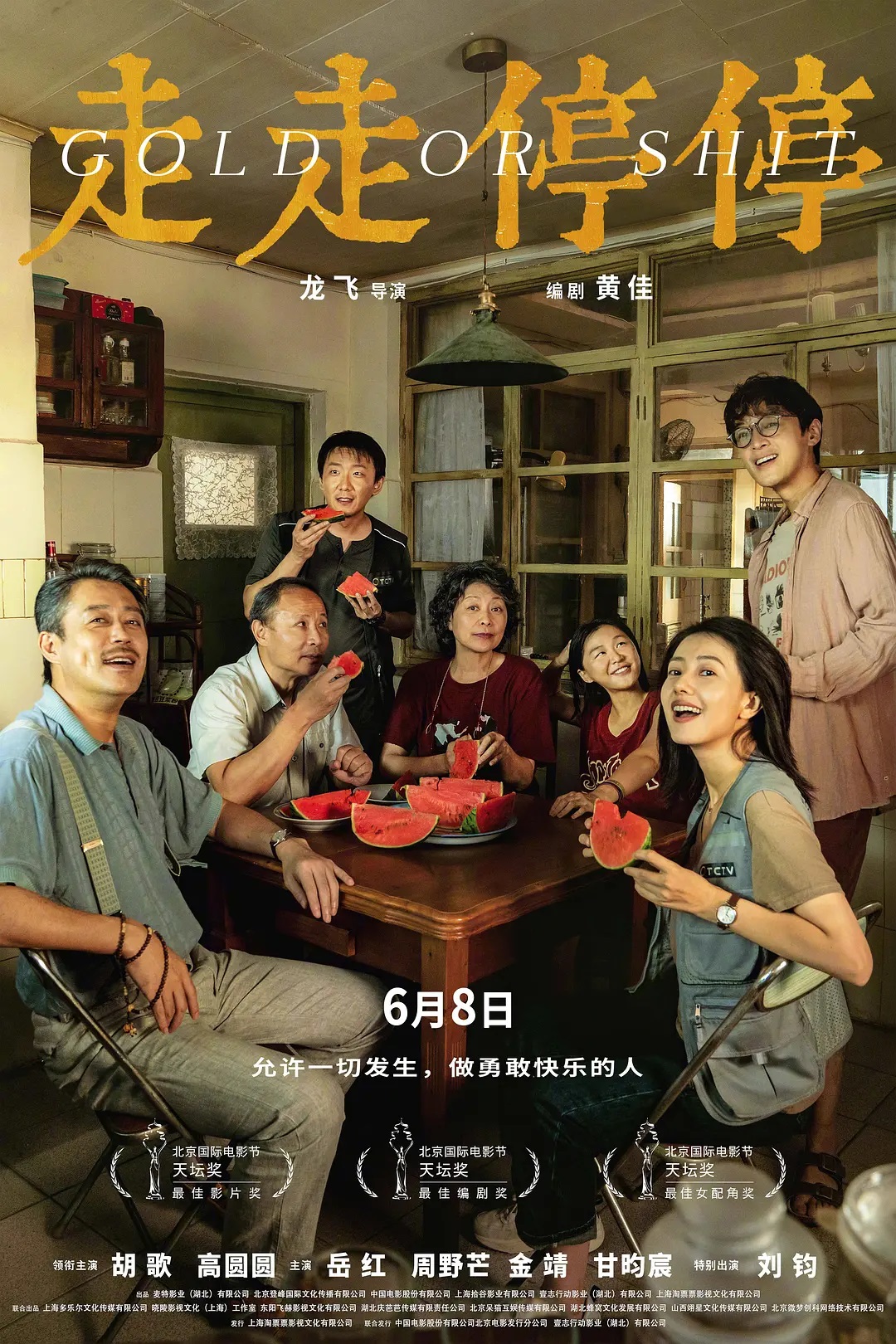 STORY
STORY
Jianggong city, Sichuan province, southwest China, summer 2020. After 10 years trying to make it as a scriptwriter in Beijing, and then being dumped by his girlfriend (Wang Zhen’er), Wu Di (Hu Ge) returns to his hometown to live with his retired father Wu Mingfa (Zhou Yeman), his mother Jiang Meiling (Yue Hong), and his younger sister Wu Shuang (Jin Jing), who’s a taxi driver and fitness fanatic. Wu Mingfa thinks his son is shit, not gold; if he was gold, he would have succeeded in Beijing. Wu Di tries for various jobs, including a teacher and a copywriter, and his father even helps to pull strings with an old friend. Then one day, while queuing for free eggs with some elderly people, he bumps into an old high-school friend, Feng Liuliu (Gao Yuanyuan), who’s a news reporter. Always the big talker, Wu Di pretends he’s “gapping”, taking a break to look after his parents – both in their early 70s – but Feng Liuliu is sceptical. She later invites him out for lunch and a catch-up chat. She’s divorced, with a young child, and now concentrates more on documentary reports than news: she invites him to be the subject of a documentary she’s planning on people who move back to their hometowns. However, Wu Di comes over as very pretentious in the film, and his family and friends have mixed feeling about him. Feng Liuliu’s boss says he’s simply a loser and tells her to drop the project. Feng Liuliu then suggests Wu Di directs a script he’s written, He Comes from Afar 似是故人来, and she makes a documentary about the whole process. Centred on two aged people, the script can be shot cheaply at Wu Di’s family home; Jiang Meiling lends her son some money from her husband’s secret nest egg, and also recommends a local actor, Li Yuan (Liu Jun), who is currently out of work and accepts. Jiang Meiling, who when younger had always dreamed of being a dancer, suddenly volunteers herself for the female role when the actress they wanted is unavailable. Feng Liuliu’s regular cameraman, Cao Yutian (Gan Yunchen), jumps at the idea of working on a feature film, and Wu Shuang handles the sound boom. As filming proceeds in a bumpy fashion, Wu Mingfa becomes jealous that Jiang Meiling is playing the role of an aged wife who has an affaire. And then a tragic event suddenly changes everything.
REVIEW
A smooth-talking loser who’s failed to make it in Beijing returns to his hometown with life-changing results in Gold or Shit 走走停停, aka G for Gap, a beautifully observed light comedy of manners that’s also stuffed with memorable performances. The second feature (and first theatrical release) of Chongqing-born director Long Fei 龙飞, following his precision piece of wry chamber cinema, Couch Boy 睡沙发的人 (2017), it also marked the return to the big screen of actress Gao Yuanyuan 高圆圆, then 44, after almost a decade. After premiering at the Beijing festival in spring 2024, it took an okay RMB103 million on release that summer.
Beijing-born Gao was one of the seminal faces of New Chinese Cinema during the first decade or so of the current century, with a string of classy performances (Shanghai Dreams 青红, 2005; City of Life and Death 南京!南京!, 2009; Driverless 无人驾驶, 2010; Don’t Go Breaking My Heart 单身男女, 2011; Caught in the Web 搜索, 2012), often but not exclusively in slickly produced comedies and dramas. However, after the smooth rom-com Let’s Get Married 咱们结婚吧 (2015), she effectively disappeared – though in 2017 she acted in the big-budget, Hong Kong-set crime thriller Sons of the Neon Night 风林火山 (only released in Oct 2025) and in Jun 2019 gave birth to a daughter by her husband, Taiwan actor Zhao Youting 赵又廷 [Mark Chao]. Shot in mid-2023, Gold was effectively her first film role in six years. She’s teamed with Shanghai-born Hu Ge 胡歌, 43, a popular TVD actor who’s too little seen (and not always at his best) on the big screen (Diva 华丽之后, 2012; Last Letter 你好,之华, 2018; most unmemorably, The Wild Goose Lake 南方车站的聚会, 2019; All Ears 不虚此行。, 2023).
The screenplay is by Huang Jia 黄佳, who also wrote Couch Boy. All her writing work has been for Long, including the eight-minute short Hongkonger 香港人 (2015), centred on a young woman who returns to her birthplace after years abroad but now feels like a stranger, and the feature film 影之痕 (literally, “Shadow Trace[s]”), a murder mystery centred on an unidentified female corpse that links back to two cases 20 years earlier. The screenplay for the latter was passed for filming in Chongqing in 2018 but so far seems not to have been made.
Gold is many things at the same time, including a light satire of no-budget arty film-making, a potential romance that never develops in an expected way, a comic look at a dysfunctional family, and a study of a smooth-talking loser who’s much more likeable that he ought to be. After all the talk of success or failure, and the main character’s tireless attempts to hide his shortcomings, the film’s broader theme is spelt out near the end: winning or losing is not as important as knowing who you are. The film’s English title refers to what the father of the main character thinks of his son when he suddenly returns home after 10 years in Beijing: if he was gold, he’d have been a success and stayed in the capital; now he’s come back here, he must be shit. The Chinese title simply means “Go Go Stop Stop”.
In a short prologue set (and shot) in Beijing, Wu Di (Hu) is shown as a garrulous loser who’s failed to make it as a scriptwriter after 10 years; his acid-tongued girlfriend dumps him, and he moves back to live with his family in Sichuan province. His retired father (Zhou Yemang 周野芒) is a self-centred, sarcastic type; his younger sister (Jin Jing 金靖) is a butch taxi-driver who’s into bodybuilding; only his tolerant, ironic mother (Yue Hong 岳红), who once dreamed of being a dancer, humours her son’s aspirations. From the outset, the dialogue establishes a tone that’s halfway between realism and light observational comedy, with the whole cast meshing in an utterly natural way. Though very little actually happens during the whole film – apart from a surprise development an hour or so in – the screenplay and performances keep the audience involved in a seemingly artless way that’s impressive – much as in Long and Huang’s earlier Couch Boy.
Wu Di’s chance meeting with an old high-school friend, Feng Liuliu (Gao), seems to set the script in the direction of a budding romance; but, again, things don’t develop as expected. Now a divorcee with a young child, and working as a TV reporter, she can clearly see all the way through Wu Di and back again – and she invites him to be the subject of her current project, about middle-agers who return to their hometown after trying to make it in the big time. This eventually leads to her encouraging Wu Di, again for her own reasons, to direct a script he once wrote about a romance between two elderly people. By chance, his own mother ends up playing the female lead, in an arty movie that’s the definition of “no-budget”.
Hu manages to evoke sympathy for a basically unsympathetic character, while Gao, looking mature and assured, is just right as the knowing, very practical TV journalist. Shanghai veteran Zhou (B for Busy 爱情神话, 2021) is fine as the embittered father who finally discovers something about himself, while a deglammed Jin is amusing as the tomboyish sister and veteran Liu Jun 刘钧 (largely a TV actor) has a discreetly larky time as the out-of-work ham hired for Wu Di’s film. But it’s Sichuan-born veteran Yue, as the mother, who’s the surprise of the whole film, in a precisely judged performance that’s real as well as engaging – an elderly woman who knows exactly what she is and (unlike her son) has long accepted it.
Smoothly, invisibly edited by Hong Kong’s Zhang Zhao 张钊, and beautifully shot in widescreen by experienced d.p. Chen Jun 陈军 (one of several pseudonyms for Xie Zhengyu 谢征宇, Gone with the Light 被光抓走的人, 2019) in a way that cleverly doesn’t detract from the story’s intimacy, the film also has an unobtrusive score by Gao Xiaoyang 高小阳 (Sister 我的姐姐, 2021) that adds to the surprising emotion of the last 10 minutes or so.
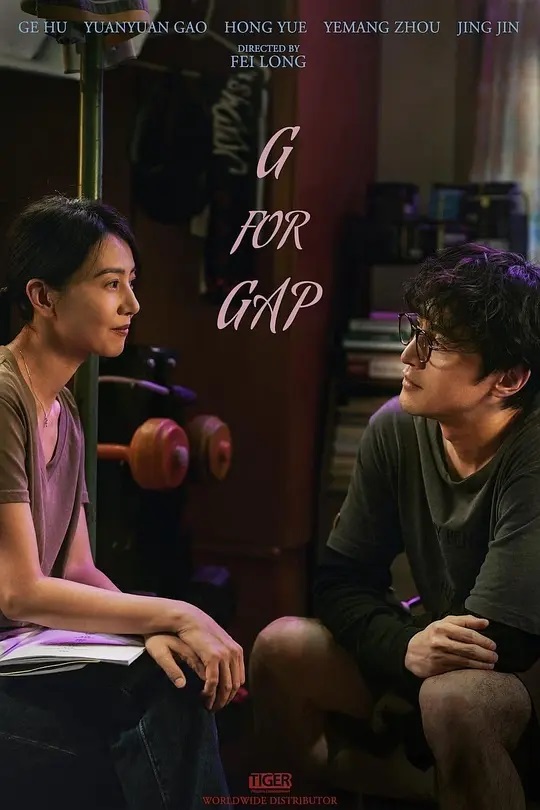 For release outside China, the English title was changed on the film and on posters to G for Gap, referring to the main character’s claim that he’s only taking a short break from his career in the capital to come and look after his aged parents. The film was shot in Beijing and various sites in Sichuan province, including Zigong and Neijiang, representing the fictional city of Jianggong. Significant chunks of the dialogue are in the Sichuan dialect.
CREDITS
Presented by MaxTimes (Hubei) (CN), Beijing Dengfeng International Culture Communication (CN), China Film (CN), Shanghai Such a Good Film (CN), Unison Frame Pictures (Hubei) (CN), Shanghai Taopiaopiao Movie & TV Culture (CN).
Script: Huang Jia. Photography: Chen Jun [Xie Zhengyu]. Editing: Zhang Zhao. Music: Gao Xiaoyang. Art direction: Wang Zichao. Styling: Tang Ning. Sound: Zhou Lei, Wu Lei. Action: Zhang Yong. Visual effects: Shi Ye (Image Architect). Executive direction: Cao Lei.
Cast: Hu Ge (Wu Di), Gao Yuanyuan (Feng Liuliu), Yue Hong (Jiang Meiling, Wu Di’s mother), Zhou Yemang (Wu Mingfa, Wu Di’s father), Jin Jing (Wu Shuang, Wu Di’s younger sister), Gan Yunchen (Cao Yutian, cameraman), Liu Jun (Li Yuan, actor), Liu Yiwei (Li, manager), Zhang Luyi (Cheng Feng, Feng Liuliu’s husband), Yuan Hong (Li Hui, Wu Di’s Beijing flatmate), Wang Zhen’er (Wu Di’s Beijing girlfriend), He Ziming (Bai), Xiao’ai (Xiong), Yang Yiwei (Da Feng).
Premiere: Beijing Film Festival (Competition), 19 Apr 2024.
Release: China, 8 Jun 2024.