Dear You
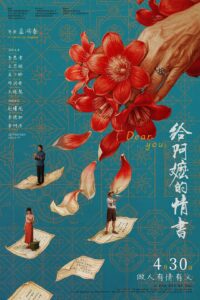
给阿嬷的情书
China, 2026, colour, 1.85:1, 117 mins.
Director: Lan Hongchun 蓝鸿春.
Rating: 7/10.
The year’s massive sleeper hit is a likeable, well-played light drama largely set among the Chaozhou [Teochew] community in 1950s Bangkok and its overseas Chinese sending remittances back home.
 STORY
STORY
A village outside Shantou city, Guangdong province, coastal southern China, 2018. Zheng Xiaowei (Zheng Runqi), who’s some RMB4 million-5 million in debt and is being hounded by a creditor, visits his grandmother, Ye Shurou (Wu Shaoqing), for her 88th birthday celebrations. Zheng Xiaowei’s visit has an ulterior motive: to find an address in Thailand for Ye Shurou’s husband, Zheng Musheng, who had fled to Southeast Asia 70 years ago, in 1948, and never returned, leaving Ye Shurou to raise their children on her own. Zheng Musheng is rumoured to have married his mistress in Thailand and become very wealthy, supporting many schools in the country. He had still sent Ye Shurou remittance letters (qiáopī 侨批) but these had suddenly stopped in 1978. Ye Shurou’s younger son, Zheng Chulong (Zheng Pengsheng), doesn’t like the money-grabbing Zheng Xiaowei but would like to contact his father to get him to name a primary school after Ye Shurou – an idea she poo-poos. He tells Zheng Xiaowei to go through all the old qiaopi that Ye Shurou still keeps upstairs to find an address – and if he gets any money out of Zheng Musheng, he’d like RMB1 million for himself. Zheng Xiaowei flies to Bangkok but no one in the Chaozhou community there appears to have heard of him – until he uses Zheng Musheng’s nickname, Tiepu 铁脯 (“Iron Chest”). He finally discovers that Zheng Musheng died in 1960, so who was sending all the qiaopi back to Ye Shurou until 1978? On a document registering his memorial tablet in a funerary home, he sees the signatory is a woman, Xie Nanzhi, who describes herself as a “relative”. (In 1945, Zheng Musheng [Wang Yantong] had met Ye Shurou [Wang Xiaohui] during the celebrations for victory over the Japanese. Both were 17; she was from a well-off family and never lacked marriage proposals. When she had fallen in love with Zheng Musheng, she had already been contracted to marry someone else, so they had eloped and moved to Chaoshan, where they had a family of one daughter and two sons. In 1948, to escape conscription during China’s Civil War, Zheng Musheng had run off to Southeast Asia, initially working in Malaya. He had sent qiaopi regularly and Ye Shurou had waited patiently for him to return… for 30 years. In 1978 many Overseas Chinese had started to return to the Mainland as life became more settled there, but not Zheng Musheng. Then a photo had arrived, with no accompanying letter, that looked like a family portrait of him, a young Chinese woman, and five children.) Zheng Xiaowei meets a man, Ma Tong, who wrote many qiaopi for Chinese at the time and who also fancied the same woman, Xie Nanzhi. He puts Zheng Xiaowei in touch with her son, Xie Zehua (Zhao Shuguang), who confirms that his mother continued to write the qiaopi to Ye Shurou after Zheng Musheng died in 1960 but that the school that now bears his name did not use any of his money. When Zhang Xiaowei demands RMB5 million, Xie Zehua just walks away. Hearing all this back in China, Ye Shurou realises it must also have been Xie Nanzhi who sent RMB1,000 to Zheng Chulong when he married in 1978; she tells him she wants to return the money to her. Subsequently, Xie Zehua informs Zheng Xiaowei that his mother and Zheng Musheng were never married and never had a family together. He then explains what was in the long letter that originally accompanied the photo but became lost en route. (It all started in 1955, when Zheng Musheng, who’d moved to Thailand after working on the railways in Malaya, stayed at a boarding house in Bangkok’s Chinatown that was run by Xie Laishun [Fang Peisong], the father of Xie Nanzhi [Li Sitong]. Zheng Musheng and another Chinese, Di Gong [Chen Qinqin}, ran a small school there for Chinese children that was illegal at the time. After initially opposing it, Xie Nanzhi, who was illiterate, ended up attending it and, thanks to many subsequent events, became Zheng Musheng’s close friend.)
REVIEW
A grandmother in her late 80s finally discovers what really happened to her husband who fled conscription 70 years ago in Dear You 给阿嬷的情书, an often gently humorous light drama centred on the overseas Chaozhou [Teochew] community in Bangkok that’s become a massive sleeper hit in China. Released some four months go, it’s taken RMB2.00 billion, for the year’s no. 3 Mainland box-office spot so far, just behind Kung Fu Soccer 功夫女足 (RMB2.29 billion) and a long way behind Pegasus 3 飞驰人生3 (RMB4.42 billion). It’s an unheard-of amount for a production of this sort – with a tiny reported budget of RMB14 million, no major stars, no action, no VFX, and played mostly in the Chaoshan 潮汕 dialect – with subtitles for general Chinese audiences. Both likeable and engaging thanks to several performances by the mostly non-professional cast, this third feature by dialect film-maker Lan Hongchun 蓝鸿春 is his best yet, though its script tends to go round in circles a lot and hardly pushes the envelope beyond familiar stereotypes.
Chaozhou is a small coastal region in the northeast of Guangdong province, southern China, that, like the neighbouring province of Fujian to the north, saw much emigration to places like Hong Kong and Southeast Asia during the chaos in the Mainland from the 1920s to late 1940s. During the first half of the 1960s, over 70 features were made in Hong Kong in the Chaozhou dialect – of which Chaoshan is a sub-set spoken in Shantou – mainly for export to Chaozhou communities in Southeast Asia and elsewhere. In the Mainland no features were made in the dialect until youth movie Love and Swatow 𬶍•恋 (2012), directed by Zheng Zhimin 郑智敏, on which Lan worked as creative producer and co-d.p. (Swatow is basically an alternative name for the Shantou/Chaoshan dialect.) Lan, born in Shantou in Sep 1985, went on to make Proud of Me 爸,我一定行的 (2018), a father-son light drama, and Back to Love 带你去见我妈 (2022), a family light drama, both with actor-writer Zheng Runqi 郑润奇. Zheng also has a leading role in Dear You, and many of the same crew from Lan’s previous two films return, such as d.p. Hai Tao 海涛 and composers Wu Zehua 吴泽华 and Li Yihan 李奕瀚.
For Chinese audiences the film has many attractive hooks, such as the importance of family roots across the ages and across countries, the strength of dialect in binding communites together (especially in an age when Mandarin has become the Chinese lingua franca), and the underlining of simple, traditional, human values (especially in an age of faceless digital technology). The film’s opening caption says it all: “A Mo [the film’s grandmother figure] says: People must uphold loyalty and friendship, and keep away from people who are heartless and ungrateful.” 阿嬷说:做人要有情义,无情无义的人能交往. Lan’s accomplishment – which resonates with non-Chinese audiences as well – is translating such heart-on-sleeve sentiments into an involving movie that doesn’t become a tear-jerking melodrama.
The general tone is set early on, as pushy young Zheng Xiaowei (played by Zheng Runqi) arrives for the 88th birthday party of his grandmother, Ye Shurou, in a village outside Shantou city. The smooth talker isn’t there out of family sentiment: he’s up to his eyeballs in debt and wants to track down Ye Shurou’s husband, Zheng Musheng, who fled to Southeast Asia in the late 1940s and never returned, though he carried on sending remittances back to her until the late 1970s and is rumoured to have made a fortune and raised another family with his mistress. Zheng Xiaowei urgently needs some of that fortune to pay off his creditors, and manages to trace him to Bangkok via the remittance letters – known as qiáopī 侨批 – that Ye Shurou still keeps in a chest upstairs.
The majority of the film is told in flashback, including an early one sketching Ye Shurou and Zheng Musheng’s elopement in 1945 and subsequent raising of a family of three. But the guts of the two-hour film is a long, central flashback – lasting some 75 minutes – to Zheng Musheng’s life in Bangkok’s Chinatown during the 1950s and his relationship with Xie Nanzhi, the daughter of his boarding-house owner. The flashback, almost as long as a feature film, is spurred by a meeting in Bangkok between Zheng Xiaowei and Xie Nanzhi’s son, a devout Buddhist who sees Zheng Xiaowei for what he is but explains what really happened back in the day.
The film is as much about the long-established habit of overseas Chinese sending back qiaopi to their families – a whole mini-industry that involved professional letter-writers (in an age when most overseas labourers were illiterate) and a vast network of people to deliver the qiaopi to addresses all over China. The practice died out in the 1980s with the return of many overseas Chinese to a more stable China and the use of official postal services and bank transfers; but the use of qiaopi is still a resonant memory of a bygone age in which communication between people required physical effort. (It’s been estimated that between 1864 and 1980 more than 36 million qiaopi were sent, worth the eqivalent of around US$10.8 billion.) The writing and sending of such letters form a significant component of the film, including the central misunderstanding that drives the whole plot.
Lan’s usual light touch in dealing with family tensions is set from the start, as the penniless but pushy Zheng Xiaowei rolls up at his grandmother’s birthday celebrations but is immediately spotted for the grifter he is, especially by an uncle (drily played by another Lan regular, Zheng Pengsheng 郑鹏生) who quietly asks for a million if Zheng Xiaowei succeeds in his mission. At the epicentre of this opening section is actress Wu Shaoqing 吴少卿, whose playing of the gnarly grandmother is a mixture of toughness and sentimentality that sets the tone of the whole movie. As Zheng Xiaowei travels to Bangkok and tries to track down his grandfather, he meets a variety of down-to-earth comic characters who claim never to have heard of him, as well as some outright hostile ones who just want a large tip for their services.
The film finally settles down some 20 or so minutes in when Zheng Xiaowei traces the son of his grandfather’s supposed mistress who – with a Buddhist calm that conquers even Zheng Xiaowei’s desperate pushiness – provides the bridge into the backstory that makes up most of the film. It’s a beautifully ironic performance by the one professional actor in the cast – veteran Zhao Shuguang 赵曙光, who recently played the crafty lead character in the Chaoshan-dialect period comedy Hey, Houlai 夏雨来 (2025, dir. Yang Qingxi 杨清希), which enjoyed a modest success on the strength of his name last summer.
As the action moves back to Bangkok in the 1950s, new leads take over the movie: Wang Yantong 王彦桐 as the young Zheng Musheng, Li Sitong 李思潼 as the Thai Chinese woman who becomes his friend, supported by Fang Peisong 方培松 as her father and Chen Qinqin 陈钦勤 as Zheng Musheng’s new pal. Playing by all these non-pros is remarkably assured, especially by Wang, 27, and Li, 22, who have a natural chemistry. Wang manages to make Zheng Musheng a sympathetic figure, while Li’s performance, blending grace, stubbornness and unspoken love, comes to anchor the whole huge flashback and makes believable the script’s central conceit of a non-romance romance.
The screenplay, initially written by Lan and Yang Leng 杨冷, later joined by Zhu Liyun 朱丽云 and producer Zheng Xuanxuan 郑萱轩, is not conventionally constructed, tending to wander down alleyways instead of taking a direct route to its next stage. As a result, and because of the number of characters, the film has no clear dramatic or emotional arcs. It could profitably lose some 10 minutes by tightening up Zheng Xiaowei’s initial search for his grandfather among Bangkok’s Chaozhou community and some of the comic byplay in the sections where he and a pal start up an (illegal) Chinese school for kids. But in general Lan’s typically light touch makes even these weaknesses no big thing, and he’s supported by a crew that, on a tiny budget, makes period Bangkok look absolutely natural thanks to meticulous research by the production team. Throughout, the score by regulars Wu and Li is warm without being lush – in other words, in tune with the movie’s overall emotional temperature. The Thai sequences have a fairly nationalistic, pro-Chinese tone – but, again, nothing excessive.
The film was largely shot around the Chaoshan region (Chaozhou, Shantou, Jieyang), with a small amount in Bangkok itself. The Chinese title literally means “A Love Letter for Granny”. For the record, the Tian Zhuangzhuang 田壮壮 credited as a stylist is not the veteran Beijing-born director of films like The Horse Thief 盗马贼 (1986) and The Blue Kite 蓝风筝 (1993), despite having exactly the same name.
CREDITS
Presented by Shenzhen King Ant Pictures (CN), Beijing Damai Entertainment Culture (CN), Rongde Holding Group (CN), Shenzhen Lichun Pictures (CN). Produced by Shenzhen Lichun Pictures (CN), Maxsfilm (Beijing) Culture Media (CN).
Script: Lan Hongchun, Zheng Xuanxuan, Yang Leng, Zhu Liyun. Photography: Hai Tao. Editing: Lang Hongchun, Peng Dong. Music: Wu Zehua, Li Yihan. Music supervision: Li Yihan. Production design: Wang Zichao. Art direction: Zhao Junxiang. Styling: Tian Zhuangzhuang, Dai Yanbing. Sound: Zhong Shangkui, Qiu Qiu.
Cast: Li Sitong (Xie Nanzhi), Wang Yantong (Zheng Musheng), Wu Shaoqing (Ye Shurou/A Mo), Zheng Runqi (Zheng Xiaowei), Wang Xiaohui (young Ye Shurou), Fang Peisong (Xie Laishun, Xie Nanzhi’s father), Zhao Shuguang (Xie Zehua, Xie Nanzhi’s adopted son), Li Deru (Auntie Ru), Li Shuhao (Shuiji, Chen Chuyuan’s father), Usha Seamkhum (old Xie Nanzhi), Zhong Shaoxian (uncle’s wife), Zheng Pengsheng (Zheng Chulong, Ye Shurou’s younger son), Xu Peitong (Thai policeman), Yao Yuan (Chen Chuyuan, one of Xie Nanzhi’s suitors), Chen Haixin (postman), Chen Qinqin (Di Gong), Cai Shanchang (remittance-letter bureau employee), Chen Jinbiao (old Qi Gong), Zheng Huisong (Kid Seventeen), Fan Chanzhen (wife of Ye Shurou’s elder son), Liu Yuxuan (young Xie Zehua).
Premiere: Shantou city, Guangdong province, China, 17 Apr 2026.
Release: China, 30 Apr 2026 (partial), 3 May 2026 (nationwide).