It’s OK
我,许可
China, 2026, colour, 2.35:1, 117 mins.
Director: Yang Li’na 杨荔钠.
Rating: 6/10.
As a determined young woman with a tricky medical problem, actress Wen Qi shows she can carry a film even opposite the experienced Qin Hailu. But despite good performances this light comedy is still way over-long.
 STORY
STORY
A city in northern China, the present day, July. At the primary school where she teaches Chinese, Xu Ke (Wen Qi), 25, enters the teachers’ race in the school games and looks certain to win until she collapses near the winning post, bleeding from between her legs. She is diagnosed with an endometrial (uterine) polyp, which can be treated by minor surgery – though as she has never had a serious relationship and is still a virgin, surgery may not be ideal, says the doctor, Chen Yu (Bai Ke). Xu Ke returns to her flat to find her manic mother, Hu Chunrong (Qin Hailu), 48, who has walked out on her husband, busily cleaning the place – which only adds to her worries. When Xu Ke gets a fever from a uterine infection, Chen Yu recommends taking progestogen to cure the fever rather than undergoing surgery to remove the polyp, even though Xu Ke stresses that her hymen isn’t important to her. When she sees one of her pupils has posted a video of her lying on the racetrack bleeding, she is forthright with her whole class, explaining all the medical details and even installing a box in the classroom with sanitary pads inside. The headmaster, Lin (Zhang Yiman), is impressed and makes her an offer to teach sex education in the next academic year. Back at the flat she rents, Xu Ke finds her mother has installed herself, pleading homelessnes and the fact that the restaurant where she worked for so long just sacked her for spitting in a customer’s food. Things quickly get tense between mother and daughter as they are forced to live together. During the summer school break, the polyp continues to get larger, and Xu Ke sees a couple of other doctors. A private one quotes her a figure of RMB20,000 for an operation, almost six months’ her salary. She finally goes back to Chen Yu, who says that, though it’s not legally necessary, he would like written approval by her family first, just to avoid any misunderstandings later. Hu Chunrong agrees to sign in exchange for Xu Ke signing a form demanded by her employment agency – though when Hu Chunrong learns her daughter is still a virgin, she refuses. Xu Ke’s best friend, book editor He Sansan (Li Xueqin), 32, suggests that she finds a man simply to puncture her hymen. Hu Chunrong finally gets a job as a nanny to a couple’s grown son; she moves out of Xu Ke’s flat but still won’t sign the surgery agreement. Meanwhile, Xu Ke saves one of her pupils, Huang Wei (Zhang Xinwen), who has taken the wrong pills to try to lose weight. As the school holidays approach their end, He Sansan sgrees to be Xu Ke’s designated guardian, a solution that Chen Yu accepts. But then Hu Chunrong suddenly leaves her new job and moves back in with her daughter, causing all sorts of problems that threaten Xu Ke’s forthcoming surgery.
REVIEW
If nothing else, I’m OK 我,许可 proves that Taiwan-born, Mainland-raised actress Wen Qi 文淇, 22, who’s made a whole career out of playing defiant, often tomboyish characters since making her first mark as the sullen drifter in Angels Wear White 嘉年华 (2017), can carry a film on the strength of her own performance – as well as, here, more than hold her own against an experienced actress like Qin Hailu 秦海璐. The light comedy about an edgy mother-daughter relationship, complicated by the latter’s medical problems, has a great first half but then fritters away its dramatic capital with many scenes that add nothing.
This structural imbalance is a common fault in the five features of Changchun-born director Yang Li’na 杨荔钠, a onetime doumentarian now in her mid-50s, here working again (after Big World 小小的我, 2024) with Sichuan scriptwriter You Xiaoying 游晓颖, 39, who also has a variable track record. (She can be seen near the end, playing a policewoman.) There’s a much better movie buried here if 20-30 minutes were lost, mostly from the second half. However, though it came nowhere near to equalling the freakish success of Big World, it still managed to take RMB192 million at the Mainland box office this spring, a reasonable amount considering its non-mainstream subject-matter and frank approach to gynaecological minutiae.
In a feature career that’s focused largely on female characters, it’s Yang’s third, after Spring Tide 春潮 (2019) and Song of Spring 妈妈! (2022), to centre on a daughter and mother – here a forthright, 25-year-old primary-school teacher who’s forged an independent life away from her parents and a dotty 48-year-old who’s walked out on her husband and now imposes herself on her daughter. Said daughter, Xu Ke (Wen), has just been diagnosed with a uterine polyp after collapsing, bleeding, during an end-of-term school race; as she’s still a virgin, her doctor advises medication rather than surgery, even though Xu Ke has no special reverence for her hymen. As she copes with all this during the school’s summer break, her mother (Qin) causes all sorts of complications, especially when she gets sacked from her long-time restaurant job for spitting in a customer’s food and later deserts a nanny job when the client’s son gropes her.
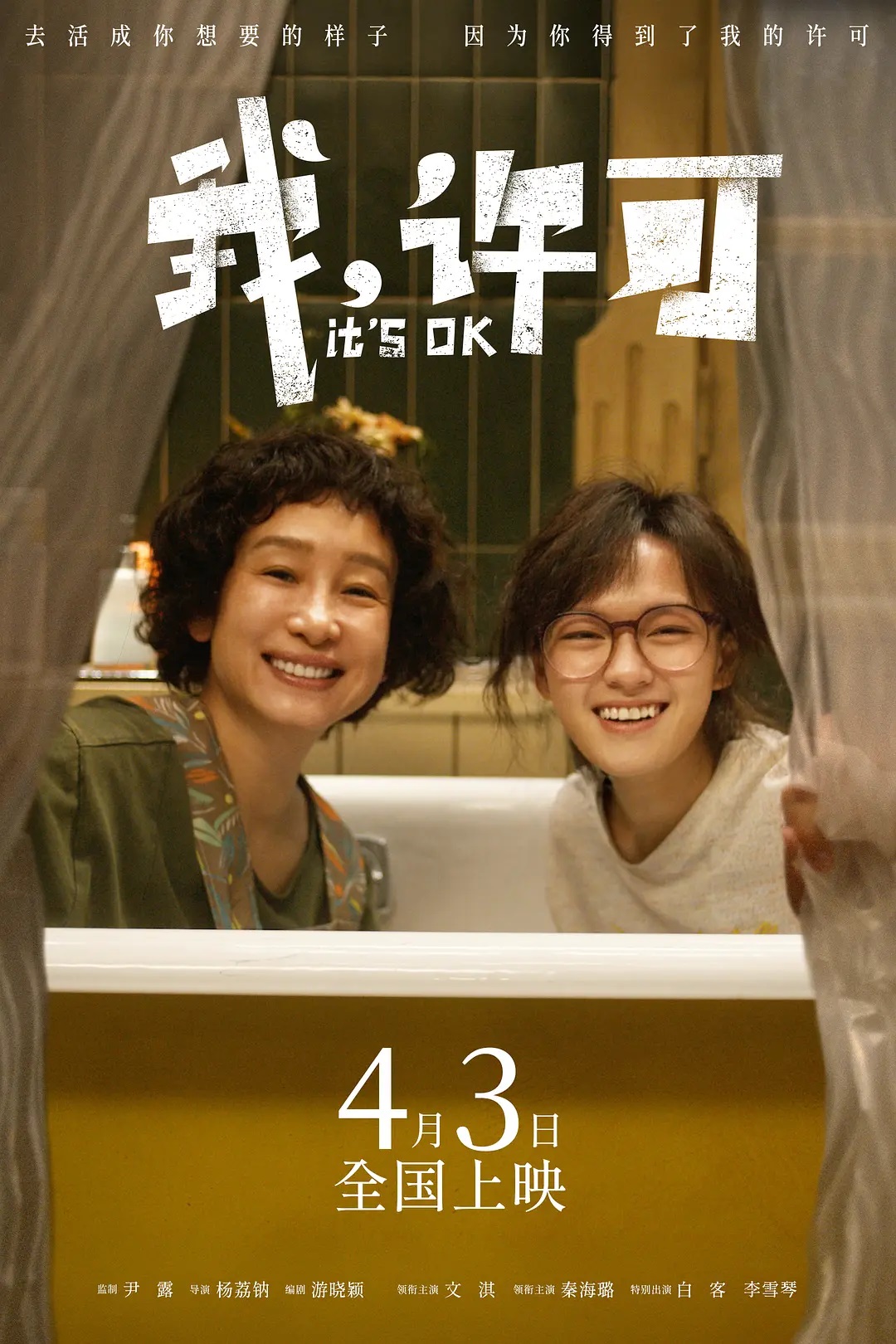
Though the script is up-front about all of Xu Ke’s medical and physical details – part of the character’s own forthrightness, even with her primary-school students – it’s largely played for laughs, as both women are equally manic and stubborn in their own ways. The tomboyish Xu Ke, all big specs, boots and untidy hair, continuously rolls her eyes at her mother’s latest eccentricities, while the latter, all curly hair and baggy trousers, adopts a look of big-eyed innocence as she further disrupts her daughter’s independence. Their eventual truce is entirely predictable; less so is the sudden resolution of Xu Ke’s surgical quandary, which seems opportunistic after all the earlier bureaucratic problems. It’s yet another structural weakness in You’s screenplay, which largely resolves the daughter’s central problem in the first hour but, when left free to explore the mother-daughter relationship in the second half, can’t come up with enough to justify another 60 minutes of screentime.
As the virgin daughter and menopausal mother, Wen and Qin have real chemistry together, but it’s the former who carries the picture, as the embodiment of its not-so-subtle message that confidence and self-belief can conquer anything. (The name of Wen’s character, Xu Ke 许可, also literally means “allowable” or “permissable” – which leads to an unnecessary vox-pop coda of young people asked what they would like to see possible in a perfect world.) Wen had a small part, as a punk teenage thief, in Yang’s Song of Spring, and several of her past roles have relied more on sullenness than subtlety. But here her range is notably broader, both likeable and exasperating in equal measure, as well as being utterly convincing, especially in the crucial plot point of why she’s never felt the need for a “serious” (i.e. sexual) relationship with a boy.
Less often seen in leading roles nowadays, though always worth watching when she is (period spy adventure Cliff Walkers 悬崖之上, 2021; anti-corruption drama The Tipping Point 扫黑行动, 2022; period whodunit All Suspects 全员嫌疑人, 2024), Qin plays a character that’s a long way from her usual strong, elegant ones. The 47-year-old is almost unrecognisable on first sight, busily cleaning and re-arranging her daughter’s flat while she’s out. Initially, the role seems over-played in its goofiness, but later scenes have a pathos that provides a nice balance to Wen’s more prickly character. Other roles are minimal, though comedienne Li Xueqin 李雪琴 (Honey Money Phony ‘骗骗’喜欢你, 2024) is simpatica as the daughter’s level-headed best friend and a nice touch is the subtly humorous playing by Bai Ke 白客 of a doctor who can never remember exactly who Xu Ke is and offers advice that’s often contradictory.
Though art director Zhai Tao 翟韬 and Hong Kong stylist Wu Lilu 吴里璐 [Dora Ng] have worked before with Yang, she has changed d.p. with every one of her features: here the widescreen photography by d.p. He Shan 何山 (Fireflies in the Sun 误杀II, 2021; Lost in the Stars 消失的她, 2022; The Open Door 人生开门红, 2025) is good-looking but natural, never getting in the way of the performances. Music, including several soundtrack songs, is bland, adding nothing. Though it’s never identified by name, the city in which the film was shot is Tianjin, southeast of Beijing. The film’s Chinese title means “I, Xu Ke”.
CREDITS
Presented by China Film (Dongyang) Production (CN), Hangzhou Pucao Film (CN), Zhejiang Hengdian Film (CN), Shanghai Eternal Stream Pictures (CN), China Film Group (CN), Tianjin Zoe Pictures (CN). Produced by Horgos Hefeng Qingmu Culture Communication (CN).
Script: You Xiaoying. Photography: He Shan. Editing: Zhou Xiaolin. Music: Hu Zi, Wang Qianting. Art direction: Zhai Tao. Costumes: Gao Mei. Styling: Wu Lilu [Dora Ng]. Sound: Si Zhonglin, Li Danfeng. Executive direction: Shang Jin.
Cast: Wen Qi (Xu Ke), Qin Hailu (Hu Chunrong), Bai Ke (Chen Yu, doctor), Li Xueqin (He Sansan), Niu Li (employer’s wife), Zhang Xinwen (Huang Wei), Liu Jia (Sun, female doctor), Chuo Ni (Sun Wei), Wang He (female teacher), Li Zheting (waiter), Zhang Yiman (Lin, headmaster), He Wenjun (employer’s son), Huang Shaofeng (singer in rock band), Huang Boyuan, Li Guanting (Xu Ke’s former boyfriends), Liao Shuyi (documentary director), Zhai Tao (head of medical affairs department), You Xiaoying (policewoman), Yu Ailei (Xu Ke’s father, voice).
Release: China, 3 Apr 2026.